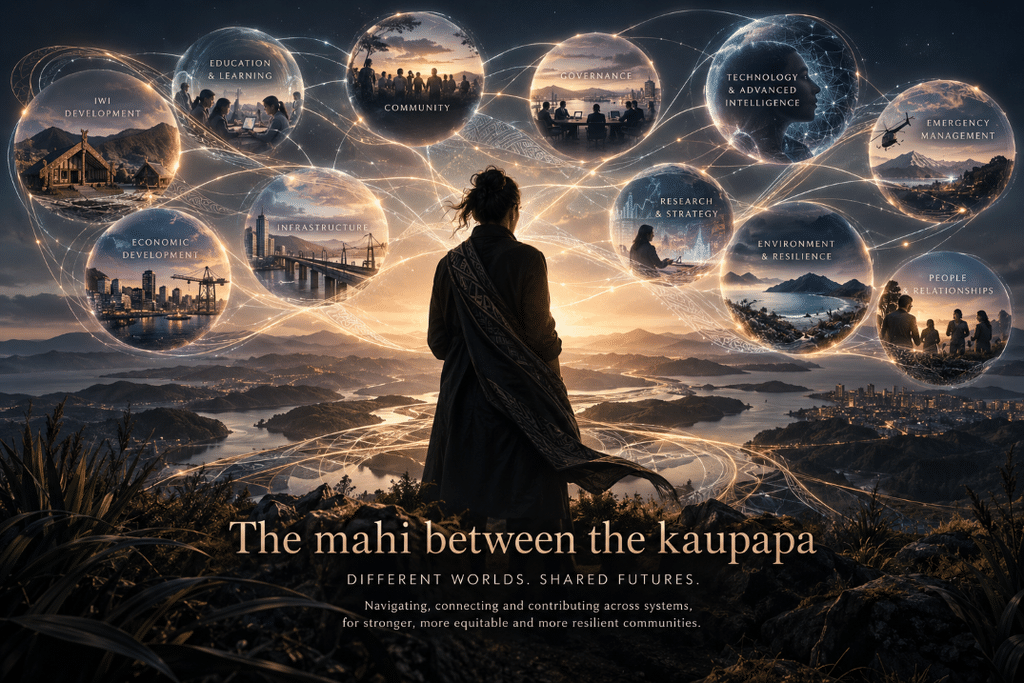
As some of you know, I work across multiple spaces: governance, technology, advanced intelligence and technologies, emergency management, education, economic development, iwi development, infrastructure, strategy, community, research and learning. From the outside, it can probably look like a lot of unrelated things, which couldn’t be further from the truth. I see connections everywhere, and I am quite strategic about where and how I serve.
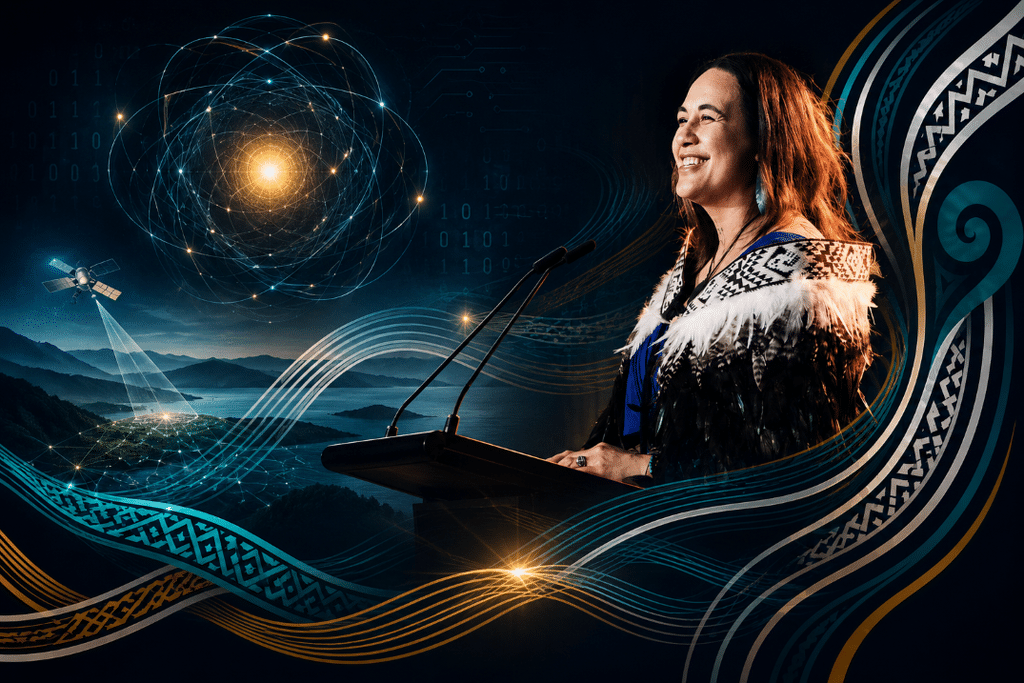
Something I learn in emergency management changes the questions I ask around a governance table. A conversation about artificial intelligence can very quickly become a conversation about workforce development, education, infrastructure, cyber security, data sovereignty and governance. Work in economic development changes how I think about technology adoption, access to capital and intergenerational strategy. Working alongside iwi and Māori communities continually challenges the assumptions underneath conventional approaches to all of those things. Increasingly, advanced technologies such as AI and quantum are connecting conversations that were once treated as belonging to entirely different sectors.
I have come to think of this as my multiverse.
The multiverse is not a collection of roles. It is a living network of people, systems, knowledge and relationships through which I move, contribute, learn and connect. I didn’t set out to build it that way. There was no beautifully designed career strategy where I sat down years ago and selected the perfect combination of sectors from which to observe the world. Much of it emerged through relationships, curiosity, service, opportunity and occasionally being in the right room when something needed doing. One kaupapa led to another. Something I learned in one environment made me useful somewhere else. Relationships opened doors to different conversations, and curiosity frequently took me through them.
The strategy came later. Over time, I began to notice a pattern in where I was contributing, what I was learning and the kinds of problems I kept being drawn towards. More importantly, I began to notice how much one environment was changing the way I understood another. Once I could see that architecture, I became much more intentional about it.
I could choose one space. There are executive roles I could take that would probably pay considerably more than this way of working. I could place most of my attention inside one organisation, one sector or one problem set and become deeply embedded there. There are certainly days when the simplicity of that is attractive. But I continue to choose the multiverse because I increasingly believe some of my most useful contribution happens between the spaces. It happens when something I have observed in one system changes how I understand another, when people who would not normally encounter one another are connected, when an emerging issue in one sector gives another sector a little more time to prepare, or when a way of thinking developed in one context helps unlock a problem somewhere completely different.
The value isn’t in knowing a little about lots of things. It is in remaining close enough to different systems, and the people within them, to notice relationships between them. That distinction matters to me because this isn’t about becoming some kind of generalist who floats across the surface of multiple disciplines. To contribute meaningfully, I still need enough depth, continuity and trust within each environment to understand something of what is actually happening there.
And that is where navigating the multiverse becomes considerably more complicated than having a busy calendar.
Different worlds, different clocks
One of the most important things I have learned is that the spaces I work within are not moving at the same speed. They are at different stages of development and have different levels of capability, resources, confidence and readiness. They also have different histories, cultures, relationships, pressures and ways of understanding the world. What constitutes an urgent issue in one environment may barely be visible in another.
One organisation might still be establishing the foundations of its digital capability while another is beginning to consider AI agents and increasingly autonomous systems. One governance table might need foundational conversations about technology risk while another is starting to grapple with frontier AI, cryptographic agility or quantum readiness. One community might need to strengthen relationships and trust before meaningful strategy can even begin, while another has already established the strategy and is wrestling with implementation, investment and measurement. Even where two spaces appear to be dealing with the same issue, what they actually require can be completely different.
That means navigating the multiverse isn’t simply about moving between different subjects. It is learning to move between different states of readiness. I can’t take something that is working in one environment and simply transplant it into another. I might be able to carry the learning, but I have to understand the context before deciding what, if anything, should travel. Sometimes an idea is right but the timing is wrong. Sometimes the capability isn’t there yet. Sometimes the relationships aren’t there yet. Sometimes the language needs to change. Sometimes an organisation simply has more immediate things it needs to deal with.
The role I play changes accordingly. Sometimes I am governing. Sometimes advising, teaching, designing, connecting or translating something highly technical into a conversation that allows people to make a decision. Sometimes I am asking uncomfortable questions. Sometimes I am listening. There are environments where I can push relatively hard because trust has accumulated over years, and others where I am new and need to understand the system before assuming I have anything useful to say.
That continual recalibration is probably one of the less visible parts of this way of working. I need to understand where I am, who I am with, what the system is ready for, what authority I actually hold, what knowledge I do not have, and what contribution is appropriate at that moment. The fact that I have seen something work somewhere else does not automatically give me the right to impose it here. Increasingly, I find myself asking not only, What can travel between these worlds? but also, When is this world ready to receive it?
Determining the multiverse strategy
If the multiverse is going to be deliberate rather than simply busy, it needs a strategy. I don’t say yes to every interesting role, kaupapa or opportunity and then try to find a connection afterwards. Increasingly, I think about what being present in a particular space allows me to see, understand, contribute to and connect with elsewhere. The multiverse itself therefore needs to be curated, and curation requires something against which to make choices. Otherwise, it simply becomes a collection of interesting things.
I have had to become clearer about the outcomes I am ultimately trying to contribute towards. They are bigger than any particular role or organisation. I want stronger communities and institutions. I want people to have greater agency over their futures. I want our systems to become more capable of dealing with complexity and change. I want Māori and our communities participating in, shaping and benefiting from the economies and technologies emerging around us. I want better stewardship of the decisions we make now because many of their consequences will be inherited by people who are not yet sitting around our tables. These aren’t KPIs. They are directional, and they help me decide whether a space belongs in my multiverse.
When I consider entering or remaining in a space, I am therefore thinking about more than the role immediately in front of me. I think about the kaupapa and the people and communities it serves. I think about what I can genuinely contribute, what I might learn, where that learning might connect, and whether my involvement creates something beyond the immediate piece of work. I ask whether the space gives me a perspective I don’t already have, whether it deepens something rather than simply adding another commitment, and whether I am contributing something distinctive or occupying a seat somebody else could fill. Increasingly, I also ask a much harder question:
what would I have to stop doing in order to say yes?
That question matters because multiverse strategy isn’t only about deciding what enters. It is also about deciding what leaves. Some spaces may be important for a period and then no longer require me. Some may develop enough capability that the right thing is for me to step away. A role might once have provided an important vantage point but eventually duplicate perspectives I now receive elsewhere. Sometimes another person is simply better positioned to take something forward. A healthy multiverse should change over time.
One of the things I value most when determining that architecture is proximity. Not proximity in the sense of access or status, but proximity to reality: real problems, people making decisions, practitioners doing the work, communities living with the consequences, and signals of what might be changing. There is a considerable difference between reading about a system and participating in one.
Being around a governance table exposes me to questions of accountability, assurance, investment and organisational risk. Working alongside practitioners exposes where strategy collides with operational reality. Emergency management makes dependencies visible that can remain almost invisible during normal conditions. Economic development puts questions of capital, capability, infrastructure and opportunity into actual businesses and communities. Education and workforce environments expose what technological and demographic change means for people preparing for work. Iwi development changes the horizon again because thinking about the next financial year is very different from thinking about what decisions might mean for mokopuna several generations from now. Technology and advanced intelligence give me another vantage point again: what might become possible, what could be disrupted, and what foundations we should perhaps be establishing before the need becomes obvious.
None of those perspectives is sufficient on its own, and none gives me a complete view. In many respects, moving between systems makes me more aware of how much I don’t see. What the multiverse gives me is multiple partial views, held by people with different knowledge, experiences and responsibilities. Sometimes the relationship between those partial views reveals something that isn’t particularly visible from inside any one of them.
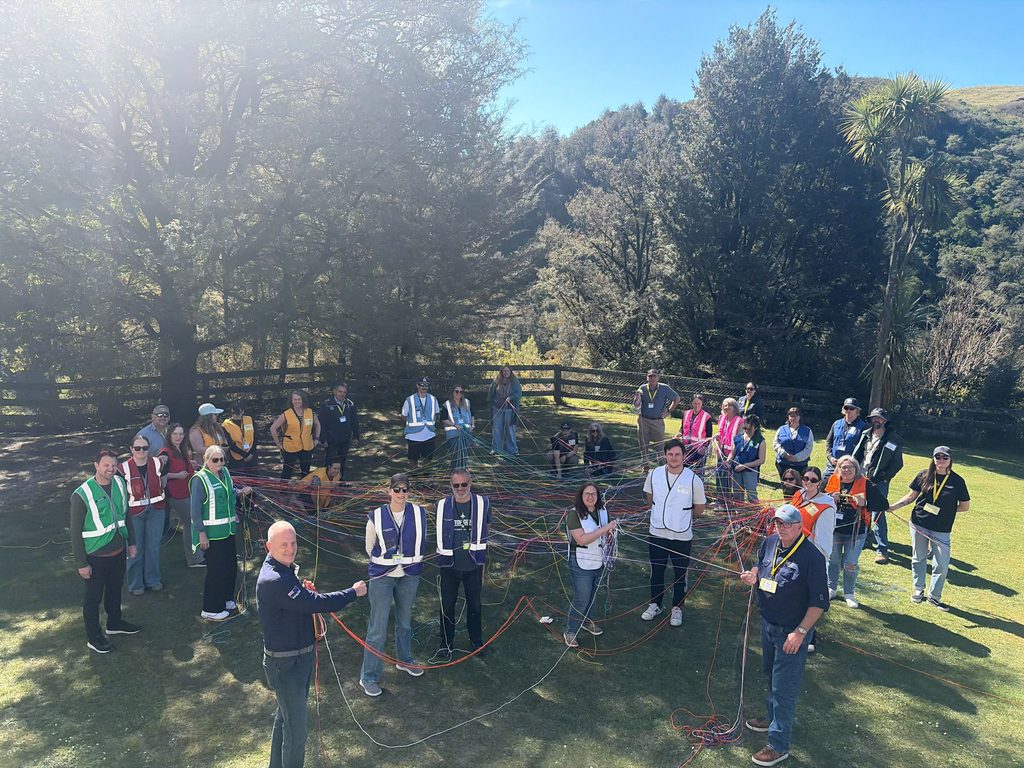
Relationships are therefore part of the infrastructure of the multiverse. I don’t move through abstract systems; I move through communities of people. Governors, practitioners, whānau, technologists, educators, emergency managers, researchers, business owners, public servants, rangatahi, kaumātua and many others hold pieces of understanding that I don’t. Navigating across worlds has taught me that knowing who understands something can be as important as understanding it myself. Sometimes my contribution isn’t an answer at all. It is knowing that two people who have never met need to have a conversation, making the introduction and then getting out of the middle.
Pulling the threads
This is where the actual work of the multiverse happens. I am not only contributing into each space. I am continually pulling key observations from each space and testing them against what I am seeing elsewhere.
I might leave an emergency management conversation thinking about digital dependency: what happens when systems that have become almost invisible because they work every day suddenly aren’t there? I can carry that question into governance. Do we actually understand what this organisation can no longer do if a critical digital service disappears? Do we understand our dependencies deeply enough to govern the consequences rather than merely the technology?
That governance conversation might then travel into education. If increasingly intelligent systems are becoming part of ordinary organisational infrastructure, are we preparing people merely to use today’s tools, or are we developing the judgement and capability required to work in environments where machines increasingly undertake parts of the work? An economic development conversation adds another layer. Who actually gets access to those capabilities? Who owns the infrastructure? Who has the capital to participate? Which businesses and communities benefit from productivity gains, and which risk becoming further marginalised? Iwi development stretches the question again: what would we build differently if the horizon wasn’t the next three years, but the next three generations?
Something that began as a conversation about digital dependency has now travelled through governance, education, workforce development, economic participation and intergenerational strategy. When it returns to emergency management, I am no longer thinking only about whether the technology works. I am thinking about who depends on it, who controls it, who can access alternatives, who has the capability to adapt, what happens when it fails, and what decisions today might change those outcomes tomorrow.
That is what I mean by connecting the multiverse.
Over time, something else has happened as well. These spaces have stopped sitting separately in my head. I don’t consciously finish an emergency management conversation, put that thinking away and open the governance folder in my brain. Increasingly, they form part of the same field of observation. When I encounter a problem, several perspectives arrive with it.
That means the multiverse is changing me as much as I am moving through it. Every new environment adds another lens, but it also changes the lenses already there. What I learn doesn’t simply accumulate; it interacts. Sometimes it contradicts something I previously believed. Sometimes it exposes an assumption I didn’t know I was carrying. Sometimes two completely different systems reveal the same underlying pattern. The result isn’t simply more knowledge. It is a continuously changing way of seeing.
The movement isn’t linear and it isn’t always conscious. I am constantly collecting what I think of as strategic fragments: a question asked around a board table, a pattern I have seen twice before, a capability gap, something a practitioner is struggling with, a new technology, a recurring governance concern, something a rangatahi says, a policy shift, a constraint facing a business, something a community is asking for, or an assumption that suddenly doesn’t seem as solid as it once did. Most of these things don’t arrive labelled strategically significant. Often they look quite ordinary.
I carry them anyway.
Some disappear because they were simply contextual. Others keep appearing. When the same underlying issue starts surfacing in environments that don’t normally talk to one another, I pay attention. When something being discussed as a future risk in one sector is already an operational reality somewhere else, I pay attention. When a capability being developed in one system could address a constraint I have observed in another, I start asking whether those worlds should meet. When different communities appear to be asking different questions but I can see the same structural issue underneath them, I pay attention to that too.
This is where the multiverse becomes more than knowledge transfer. It becomes a form of continuous sense-making. The question isn’t simply, What did I learn here that I can use over there? It becomes, What am I able to see because I can see both? And sometimes, What am I beginning to see because I can see several?
Importantly, seeing a connection does not automatically mean acting on it. Not every signal needs a strategy, not every connection needs a programme, and not every interesting idea needs me to turn it into another blardy project. Sometimes the appropriate response is to name something. Sometimes I introduce two people. Sometimes I carry a question into another room, put something into a risk conversation, write about it or teach it. Sometimes I help establish enough of a foundation that somebody else can carry the work forward. And sometimes I simply keep watching.
There is an ethical boundary around this movement as well. Working across multiple environments creates responsibilities around trust, confidentiality, commercial information, cultural knowledge, relationships and mātauranga. Being trusted inside one world does not give me permission to carry that world’s information into another. What travels through the multiverse is not necessarily information; it is learning. I can recognise a pattern without disclosing where I first observed it. I can carry a question without carrying the confidential circumstances that produced it. I can understand a system differently because of something somebody has taught me without appropriating their knowledge or retelling their story. Sometimes nothing should travel at all.
The strategy therefore operates as a feedback loop. I enter spaces where I believe I can serve and learn, contribute while I am there, observe what the system is telling me, pull out things that may have significance beyond their immediate context, test them against what I am seeing elsewhere, connect or translate where there is genuine value, watch what happens next and allow that learning to inform what I subsequently do. Then I reassess, because the multiverse itself has to learn.
A space that was strategically important to me five years ago may not be the space I need to occupy five years from now. A capability I once needed to carry personally may now need succession. An emerging field might become important enough that I deliberately create proximity to it. A connection I thought mattered might turn out not to. The architecture should move as the world moves.
My emergency management work makes me a different governor. Governance makes me a different technologist. Technology changes how I think about economic development. Economic development changes how I think about education, infrastructure and access. Iwi development changes the time horizons I apply to all of them. Learning te reo Māori and deepening my understanding of whakapapa and mātauranga changes the way I understand knowledge, relationship and responsibility. All of those experiences change the questions I carry into the next room.
I don’t need representation in every world. I need enough diversity of perspective to keep disrupting my own assumptions, enough depth to contribute rather than merely observe, enough continuity to see change over time, and enough movement between systems to notice what becomes visible at their intersections. The strategy isn’t more spaces, more roles or more work. It is the right proximity to the right systems, for the right reasons, connected deliberately towards something larger than any one of them.
Seeing around corners, and learning to say no
There is, however, a problem with training yourself to notice connections.
My mind naturally moves towards what might be coming next. I notice weak signals, make connections and think about second and third-order consequences. Years of working across strategy, technology, governance, emergency management and complex systems have probably strengthened something that was already fairly natural to me. When somebody puts what appears to be an isolated issue in front of me, my brain rarely leaves it isolated for very long. I start thinking about what that decision might enable later, what dependency we might inadvertently be creating, what capability we will need if a technology continues developing, where the constraint might eventually appear, and whether I have seen a similar pattern emerging somewhere else.
Sometimes that is useful. Sometimes it is blardy inconvenient, because it makes saying no surprisingly difficult.
The difficulty isn’t simply that I care about the kaupapa or that people ask me to help. Sometimes I can see why something that doesn’t require much attention today might require considerable attention tomorrow. I know that a relatively small amount of thinking now might establish foundations that make a future transition much easier. If I only respond to what is urgent today, I risk becoming entirely reactive, and some of the most valuable strategic work happens precisely when there isn’t yet a crisis demanding it.
Emergency management has reinforced that thinking for me. We don’t wait for an emergency to begin before deciding whether preparedness matters. Resilience is built before it is tested. The same principle applies to governance, technology, infrastructure, workforce capability, economic development and many of the other systems I work within. Sometimes doing a relatively small amount now genuinely can prevent a much larger problem later.
But there is a trap in that logic. When you can see downstream consequences, almost everything can justify some level of attention. There will always be another useful conversation I could have, another introduction I could make, another emerging risk worth exploring or another foundation that could be strengthened. Foresight can become an almost unlimited justification for involvement.
That isn’t sustainable.
So I am having to learn that recognising a signal does not automatically make me responsible for responding to it. There is a difference between knowing that I can help, deciding that I should help, determining whether I need to help now, and asking whether I am actually the person who needs to help at all. Increasingly, I am also asking whether I can leave something useful behind – a question, a framework, an introduction, a warning or a piece of thinking – without becoming responsible for everything that follows.
Foresight does not require ownership.
I am still learning that.
Perhaps the bigger lesson is that everything can be connected without requiring me to remain connected to everything. When you work across systems, there will always be another relationship worth developing, another emerging issue worth exploring, another conference worth attending, another working group worth joining, another paper worth reading and another kaupapa where you could potentially contribute. Because I operate across several sectors, I am exposed to the calendars of several sectors as well. Each has its conferences, forums, strategy days, workshops, governance cycles, professional development and important conversations. Individually, many of those invitations are genuinely valuable. The problem appears when you add them together.
There is another dynamic I have noticed. You might enter a space because of one particular capability, and over time people discover the other things you know how to do. The governance contribution becomes a technology conversation. The technology conversation reveals strategy capability. The strategy conversation uncovers facilitation, economic development, AI, risk, infrastructure or something else. Then another question arrives, then another piece of work, and eventually somebody says, “While we’ve got you…”
I have occasionally caught myself deliberately not showing everything I know how to do. I don’t particularly like admitting that because it could sound as though I am trying to manufacture some mystique around my capability. I’m not. It is much more practical. I know that demonstrating another capability can create another expectation of contribution, and sometimes I simply don’t have anywhere to put that expectation.
I don’t think making myself smaller is the answer. The better answer is learning to bound access to my capability. That means becoming comfortable saying that yes, I can do something, but it isn’t part of what I am here to do. Or yes, I can help, but it needs to be scoped as a separate piece of work. Or perhaps I know somebody better positioned to carry it. And sometimes the answer simply has to be no, because I do not have the capacity.
That sounds remarkably straightforward written on a page.
In practice, it is one of the hardest parts of navigating the multiverse.
There is an economics to this choice
People sometimes ask how this way of working actually works financially, and I think that is a fair question. We often talk about purpose, service and portfolio careers without talking about the economic architecture required to sustain them.
For me, there are different forms of contribution. Some of my governance roles are paid, and that income matters. It contributes to the ordinary realities of our household, including paying the mortgage. My contracting work runs through ELG, which gives me a commercial home for project and advisory work. Depending on the kaupapa, that might mean an hourly rate, a daily rate, a monthly arrangement or an agreed amount for a larger body of work. Then there is mahi I choose to contribute because I believe in it, because it serves communities I care about, because I am learning, or because sometimes the right thing is simply to help.
The boundaries between those categories haven’t always been as clear as they should be, and I am getting better at that. Being capable of contributing does not create an obligation to provide that capability indefinitely. Being passionate about something does not mean it should always be done for free. Service does not require the absence of commercial boundaries.
I have also turned down roles that would have provided considerably greater income and financial certainty. I don’t say that because earning well is somehow less worthy. Financial security matters, particularly when you have a mortgage, whānau and people you care about and support. There is a very real opportunity cost to choosing this architecture.
At this stage of my life, however, I believe there is value in maintaining enough proximity to several systems that I can continue to see what is happening between them. Taking a full-time executive role in one system would allow me to go much deeper into that particular environment, and I know I could contribute there. It would also inevitably reduce my ability to remain present across others.
That is a choice I continue to make consciously. The multiverse isn’t a clever way of maximising income. In some respects, I suspect I have deliberately done the opposite. The return I am seeking is different: the ability to connect systems, move learning, strengthen foundations, contribute to decisions and help prepare for things that may be approaching from beyond the immediate horizon.
That doesn’t pay the mortgage by itself, of course.
Hence the architecture.
The cognitive load is real
There is another cost to this way of working that is considerably harder to put into a spreadsheet: cognitive load. Every environment has its own language, relationships, history, personalities, risks, acronyms, expectations and unfinished conversations. Moving from one to another isn’t simply changing meetings. You have to reload the world.
A governance meeting requires one type of attention. A strategy session another. A whānau conversation another. Teaching another. Emergency management another. A conversation about emerging technology might require me to move between technical possibility, governance implications, public policy, ethics, implementation and human consequence within the same hour.
I have become reasonably good at changing altitude quickly. I can zoom out to look at a system, zoom into a particular problem and then move sideways to consider how another system might understand it. I can hold quite a lot of context while doing that, but quickly isn’t the same as freely. It consumes cognitive capacity.
This is where my relationship with artificial intelligence has become particularly important. AI has moved well beyond occasionally asking a chatbot to draft something for me. It has become part of the cognitive infrastructure around my work. The human-machine relationship helps me retain and retrieve context, interrogate thinking, synthesise large amounts of information, test connections, challenge assumptions, develop artefacts and move from thought to something usable much faster than I could manually. It helps me maintain continuity between conversations that might otherwise be separated by months and dozens of other pieces of work.
That does not outsource my judgement. I still hold the relationships, accountability, decisions, lived experience, cultural context and responsibility for what I put into the world. But increasingly I don’t think about AI as simply another productivity tool. It is part of the architecture that allows me to navigate complexity.
And that has revealed another uncomfortable truth:
technology can increase the amount a human can carry without necessarily increasing the amount a human should carry.
Being able to produce the paper faster creates room for another paper. Being able to synthesise information more quickly creates capacity for another meeting. Being able to maintain more context creates the possibility of carrying more contexts. Efficiency can hide overload, and at some point augmentation without boundaries simply creates a more efficient overloaded human.
I am watching that carefully.
There is a life inside the multiverse too
People occasionally ask me how I balance all of this. The truthful answer is that I haven’t found balance.
My husband and I haven’t taken a proper holiday this year, and I can feel that now. There are weeks when things are beautifully organised and I feel well ahead of myself. There are other weeks when I am developing the PowerPoint immediately before I need to present the PowerPoint. Sometimes I am moving from one commitment to another while simultaneously pulling together threads from five other things in my head.
And then there is life. There is my husband, my parents, whānau, friends and all the ordinary responsibilities that come with loving people and being part of a family. There is kura reo and my own learning. There are books I want to write and ideas I want enough quiet to think about properly. I want to undertake my PhD. There are deeply personal decisions and possibilities that Dave and I are navigating about our own future.
These things do not sit neatly outside the professional multiverse. They are part of it because they are part of me.
That matters because discussions about high performance and portfolio working can become strangely sanitised. We talk about calendars, routines, productivity systems and optimisation as though the human being at the centre of them can be engineered into perfect efficiency. I don’t experience life that way. Some days whānau needs more of me. Some weeks one kaupapa needs considerably more attention than expected. Sometimes something I thought would take an hour takes a day. Sometimes an opportunity arrives that is too important to ignore. Sometimes I am simply tired.
So I don’t have a beautifully packaged answer about work-life balance. I haven’t cracked it.
At the moment, I can feel the accumulation of a year without enough proper rest. I can feel that I need to become better at saying no. I can also see how easily the very things that make this way of working valuable can become the things that make it unsustainable.
I think that is worth being truthful about.
Perhaps tiredness is information
I don’t think being tired necessarily means the architecture is wrong. I have been working in variations of this way for several years now, and it has allowed me to contribute to things I care deeply about. It has also allowed me to see relationships that I genuinely don’t think I would have seen from inside a single institution.
But perhaps tiredness is information from the system.
The question I am beginning to ask isn’t how I become even better at carrying the multiverse.
It is how does the multiverse become less dependent on me carrying it?
That takes me somewhere quite different. It takes me towards succession, clearer commercial boundaries and stronger decisions about where my particular contribution is genuinely required and where somebody else should be given the opportunity. It means capturing knowledge so it doesn’t remain solely inside my head, connecting people and then getting out of the way, and protecting time for learning, thinking and writing rather than allowing those things to survive only in whatever space remains.
It also makes me think differently about what I am actually building. Perhaps the long-term answer isn’t simply becoming a better individual multiverse navigator. Perhaps it is building an architecture through which other people can navigate these intersections too. A multiverse agency of sorts, not necessarily a conventional consultancy, but a network of people, capabilities, relationships and intelligent systems able to carry different parts of the work without everything converging through one person.
There is an irony here that isn’t lost on me. I can already see what that might become, and my immediate instinct is to start designing it.
Maybe, for once, noticing the signal is enough.
The mahi between the kaupapa
When I first began working this way, I thought the challenge would be learning enough to contribute meaningfully across different worlds. Increasingly, I think the harder challenge is deciding where not to contribute.
Navigating the multiverse is not about being everywhere, knowing everything or making myself indispensable. If this way of working is going to remain sustainable, I suspect the opposite has to become true. I need to become better at recognising what is mine to carry and what belongs somewhere else; what should be paid for and what I consciously choose to contribute; what needs my involvement and what simply needs an introduction; what requires foundations to be laid now and what can wait; what needs to be carried forward by somebody else; and what simply needs a no.
I also need to protect the reason I chose this architecture in the first place. The purpose was never to accumulate work. The purpose was to maintain enough movement between worlds that I could see the connections.
Increasingly, I believe some of the most important things we need to understand are not sitting neatly inside sectors, organisations or disciplines. They are emerging between them. Technology is becoming an education issue, an infrastructure issue, a sovereignty issue, a workforce issue, an economic issue and a governance issue. Resilience, climate, demographic change, technological change and economic development intersect. Decisions made in one system create consequences somewhere else. The boundaries we have built around institutions and professions do not necessarily reflect the way the world actually behaves.
That means there is value in people who keep crossing those boundaries: people who carry questions between rooms, who notice when a signal appearing in one world might matter to another, who can translate without assuming everything should be made the same, and who can connect partial views without pretending that doing so gives them the whole picture.
I have chosen, at least for this period of my life, to be one of those people.
The challenge now is learning how to do that without believing I need to carry every world I enter.
Perhaps that is what navigating the multiverse really means. It isn’t being everywhere or doing everything. It is moving deliberately between worlds, paying attention to what becomes visible at their edges, allowing each to change the way you see the others, and developing the judgement to know when to contribute, when to connect, when to prepare, when to leave something behind and when to keep walking.
Whakaingoatanga is about more than reclaiming a name. It is an act of identity, belonging and whakapapa - and for me, it was also kaupapa ora: a delib...
Quantum readiness is no longer simply about preparing for a more powerful computer. It is about designing architectures capable of sustaining trust as...
Quantum isn't waiting somewhere in the future to arrive. Its infrastructure, standards, security models, talent pipelines and sovereign capabilities a...