My Why – Tāku Hei Aha
a World of Unity and Exploration

I have spent much of my life moving between worlds: science and technology, infrastructure and emergency management, governance and community, business and education, te ao Māori and the many cultures, disciplines and communities that have shaped me. For a long time, I described this as my multiverse. I still do.
Over time, though, I have come to understand that the value of moving between these worlds is not simply the breadth of experience it creates. It is what becomes visible when you are able to observe across them. Different environments may have their own language, tikanga, structures and measures of success, yet many of the same questions about trust, power, participation, leadership, knowledge, technology and human behaviour appear again and again.
That observation has become an important thread connecting my mahi. I am interested in how systems behave, how people participate within them, and what enables people, organisations, communities and generations to flourish. Increasingly, I find myself looking not only at what a system does, but at the relationships, assumptions and conditions beneath it that influence what becomes possible.
I have come to this thinking through practice rather than from a single discipline. Nearly three decades of learning, doing, succeeding, failing, adapting, teaching, governing, building and sometimes simply sitting quietly enough to notice have shaped the way I see the world. Science taught me to remain curious. Technology taught me about possibility and consequence. Infrastructure taught me about dependency. Emergency management taught me to understand systems under pressure. Governance taught me the weight of decision-making. Whakapapa reminds me that none of us begins with ourselves, and that what we do in our time becomes part of what others inherit.
I am still moving between worlds, still learning and still testing what I think I know. But I am also becoming more deliberate about documenting what I observe along the way. Much of my writing and mahi now explores stewardship, complexity, participation, technology, whakapapa and human flourishing, and the connections that exist between them.
This website is where those worlds come together. It holds some of what I do, some of what I have learned, and increasingly, some of what I am beginning to see.
Here, unity is not just a concept; it’s a mechanism to drive inclusive exploration. It’s about venturing together into the realms of knowledge, understanding our place, and determining our direction in the vast universe. This pursuit is more than a personal passion; it’s a collective quest to understand humanity’s role and potential.
As you navigate through my site, you’ll discover the various ways in which I contribute to this kaupapa, my mission. From innovative projects to insightful discussions, each aspect reflects a commitment to unity, equity, and the boundless pursuit of knowledge. Welcome to a space where together, we explore, learn, and grow towards a unified future.
Whakapapa – Māori ki te Ao
Whakapapa – The Importance of Ancestry
Where I Stand
Kia whakatōmuri te haere whakamua.
Whakapapa has become increasingly important to how I understand not only who I am, but where I stand. It connects me backwards through generations I am still learning about, outwards through whānau and relationships that continue to unfold, and forwards to mokopuna who will inherit stories, decisions and consequences from us. The more I learn about my whakapapa, the less I experience it as a list of names or affiliations. It is relationship, place, memory and responsibility.
I am whāngai. I grew within the protective arms of the whānau who raised me, while later in life beginning the long journey of reconnecting with my whakapapa of birth. That journey has taken me into archives, around kitchen tables, onto marae, into wānanga, and into kōrero with kaumātua and whānau who carry pieces of knowledge that no database could ever hold. In 2026, reclaiming my whānau name, Paraku, became another step in that journey – not an ending or a declaration that I now know everything, but an acknowledgement of what had been returned to me and what I now have a responsibility to carry with care.
Ko au he uri nō Marutūāhu, nō te whakaminenga o Pare Hauraki. My whakapapa connects me most closely with Ngāti Tamaterā, alongside Ngāti Pāoa, Ngāti Hako and Ngāti Maru, and through other lines with Ngāti Raukawa, Ngāti Porou, Ngāpuhi and Ngāi Tūhoe. My whakapapa reaches across Aotearoa, while Ōtautahi is the place I now call home and from where much of my mahi begins.
One of the greatest lessons of this journey has been learning not to force whakapapa into certainty simply because certainty feels more comfortable. Different sources sometimes tell different stories. Names change across records. Memories differ. Some connections can be evidenced strongly; others remain possibilities requiring further kōrero. I have learned to hold those differences with curiosity rather than trying to make every version agree. The purpose, for me, is not to establish status or what my whakapapa might entitle me to. It is to understand the truth of my connections as carefully as I can.
That has changed my understanding of ancestry itself. I don’t think of whakapapa as something I own. I am one living point within it. For a relatively short period of time, stories, relationships and knowledge pass through my generation. What we recover, what we protect, what we contribute and what we pass forward will become part of somebody else’s understanding of where they stand.
Perhaps that is why whakapapa increasingly influences the way I think about everything else. It challenges the idea that any of us is self-made or stands independently of what came before. It asks us to locate ourselves within a much longer story.
We inherit. We contribute. We pass forward.

Through us, we create a future for our grandchildren, built upon the shoulders of giants, our ancestors – such is the intergenerational story we are all a part of.
Embracing Omni-Culturalism
Waiho i te toipoto, kaua i te toiroa.
My interest in omni-culturalism began with something deeply personal. My whakapapa, whāngai experience, travel, mahi and relationships have placed me amongst many cultures and communities throughout my life. I learned early that there is more than one way to understand the world, organise knowledge, express belonging, solve problems or define what matters.
For a time, I thought the opportunity within that diversity was integration: finding common ground, bringing different perspectives together and creating something more unified from them. I still believe deeply in connection, but my thinking has changed. I no longer believe connection requires convergence. We do not have to become more alike in order to stand alongside one another.
Omni-culturalism, as I now understand it, is not the blending of cultures into one harmonious whole. It is the ability to recognise that multiple cultural worlds, knowledge systems and ways of being can exist at the same time, each with their own whakapapa and integrity. There will be places where they align, places where they complement one another, and places where they do not agree at all. Difference is not necessarily a problem requiring resolution.
This matters because much of my mahi happens at the intersections between worlds. I have sat in spaces shaped by mātauranga Māori, science, technology, governance, business, education, emergency management and community knowledge. Each carries assumptions about what constitutes evidence, who holds authority, how decisions should be made and what a good outcome looks like. Moving between them has taught me that the challenge is not simply bringing different people into the same room. It is creating the conditions in which different ways of knowing can remain present, be heard and contribute without one automatically becoming the measure against which all others are judged.
My own whakapapa is part of how I came to this thinking, but it is no longer the argument for it. Having multiple ancestral and cultural connections does not make me representative of every culture within them, nor does it give me authority to speak for those cultures. If anything, learning more about whakapapa has made me more conscious of where I stand, what I know, what I do not know, and the importance of recognising the mana and authority of others.
This is where omni-culturalism increasingly intersects with my thinking about stewardship. Stewardship asks something different from ownership or control. It asks how we behave while something is within our influence or care. In an omni-cultural world, that includes how we hold space for knowledge that is not ours, how we make decisions across different worldviews, how we recognise authority beyond our own, and how we resist the temptation to translate everything into a framework with which we are already comfortable.
I am still exploring what this means in practice. Increasingly, though, I believe our ability to navigate complexity will depend not upon finding one worldview capable of explaining everything, but upon becoming more capable of standing respectfully amongst many.
The goal is not sameness.
It is relationship without erasure.
My Multiverse
Whaia te pae tawhiti kia tata.
My professional life has never fitted neatly into a single sector, discipline or role. I move across governance, technology, emergency management, economic development, education, infrastructure, mātauranga Māori, advanced technologies and community. For a long time, I wondered whether I was supposed to narrow that world, choose a lane, or become known for one particular thing. Eventually I realised that moving between these spaces was not a distraction from the mahi. It was part of it.
I call this my multiverse.
Each world has its own language, tikanga, relationships, pace, incentives and understanding of what matters. A governance table moves differently from an emergency operations environment. Iwi development moves differently from technology. Science asks different questions from economic development. Community operates differently again. I have learned that moving well between these worlds requires more than carrying knowledge from one into another. First, I have to understand the world I am standing in.
At the same time, moving between worlds makes certain things visible. A pattern emerging in technology may have implications for education. A conversation about infrastructure may reveal an emergency management dependency. Something learned through iwi development may fundamentally change the way I approach governance. A question arising in science may eventually become a question about people, power or participation. The spaces may appear separate when viewed individually, but from further out, relationships begin to emerge between them.
That is why I naturally move between two perspectives. I zoom out to see the wider system: relationships, dependencies, patterns, tensions, consequences and possibilities. Then I zoom back in and ask what can actually be done here, with these people, in these circumstances. I have little interest in strategy that cannot eventually meet practice. Foresight has value when it helps us make better decisions in the present.
There is, however, a cost to seeing across systems. When you can see connections, it is very easy to begin carrying them. Capability attracts demand, and the more worlds you can navigate, the easier it becomes to find yourself responsible for connecting all of them. One of my harder lessons has therefore been learning the difference between what I can see, what I can do, and what is actually mine to carry.
I am still learning that lesson.
Foresight does not require ownership. Capability does not require ownership either. Sometimes my contribution is to lead. Sometimes it is to connect people or ideas that might not otherwise meet. Sometimes it is to ask the question nobody has asked yet. And sometimes the most useful thing I can do is step away, creating space for somebody else to develop the capability, confidence and relationships to carry the mahi themselves.
This has changed the way I think about succession too. Succession is not simply preparing somebody to replace us when we leave. It can begin much earlier, through the deliberate distribution of knowledge, opportunity, relationships and responsibility. Carrying less ourselves can sometimes create the conditions for others to carry more.
My multiverse is therefore not a collection of jobs, nor is it about being busy across many things. It is a way of navigating complexity: moving between worlds while respecting the integrity of each, noticing what connects them, understanding where I can contribute, and becoming increasingly deliberate about where I should not.
There are different worlds, and different clocks.
The practice is learning how to move between them without believing that I need to own them all.

Science and the Natural World
A Symphony of Interconnected Realms: Bridging the Hard Sciences with Integrated Technologies
Mai i te korekore ki te whei ao ki te ao mārama.
My love of science began long before it became part of my professional life. From a young age I was fascinated by physics, and particularly by the questions that sit at the edges of what we can readily see or comprehend. I wanted to understand how the universe worked: matter, energy, forces, time, space, and eventually the strange and compelling world of quantum mechanics. I was the kid reading about theoretical physics and wondering what existed beneath the reality we experience every day.
That curiosity has never really left me. If anything, it has become one of the more enduring threads running through my life. I am still fascinated by the idea that the world we experience at human scale is underpinned by interactions, forces and relationships that we cannot necessarily see, yet which fundamentally shape what becomes possible. Looking back, I can see how much that early fascination influenced the way I later approached technology, systems and even people: I have always wanted to know what is happening beneath the surface.
My professional life gave that curiosity somewhere practical to go. I moved into survey instrumentation, geospatial technologies, electromagnetics, radar, interferometry, ultrasonics and infrastructure. Frequency became particularly fascinating to me. Technologies that allowed us to detect, locate, measure and interpret things beyond our immediate senses felt like an extension of the questions I had been asking since I was young. What began with individual instruments gradually became an exploration of how different sciences and technologies could work together to understand much more complex environments.
Mātauranga Māori has added another dimension to this journey. It continues to challenge me to examine the boundaries we construct between disciplines, between observer and observed, and between people and the environments of which we are part. I do not regard mātauranga Māori and Western science as interchangeable knowledge systems, nor do I believe one needs to be translated through the language of the other to establish its legitimacy. I am much more interested in our capacity to respect the integrity of different ways of knowing while remaining curious about where their questions, observations and insights may encounter one another.
There is something wonderfully circular about finding myself, all these years later, working around artificial intelligence, digital infrastructure, quantum, photonics and other advanced technologies. Quantum mechanics in particular no longer belongs only to the books and ideas that fascinated me when I was young; we are entering an era in which quantum science is increasingly becoming technology, infrastructure, capability and industry.
Yet the technologies may have changed considerably, while many of my pātai have not. What does this allow us to see or do that we could not before? What becomes possible when different technologies converge? What dependencies are we creating? Who has the capability to participate? Who benefits? What consequences can we already anticipate, and which ones are we not yet capable of seeing? And increasingly, just because we can, should we?
Science taught me to explore possibility, but it also taught me to observe carefully. The natural world continually reminds me that everything we create exists within systems far larger and older than ourselves. My fascination with science and technology has therefore never really been about the technology alone. It is about understanding what lies beneath the surface, what our discoveries reveal, what they allow us to change, and what we choose to do with that knowledge.

For around fifteen years, I worked across Science, Technology, Engineering, Art/Creation and Mathematics, from relatively simple survey instruments through to integrated geospatial and environmental technologies. Much of that work sat within infrastructure, where theory very quickly meets reality. You can understand the science, but eventually somebody has to take the instrument into the field, interpret what it is telling them, make a decision and live with the consequences.
For part of that journey, I co-owned and operated a service department that became something of a laboratory. Alongside a team of technicians and fellow explorers, we built, tested, repaired, calibrated and sometimes broke things while trying to understand how they worked and what else might be possible. We experimented, failed, adjusted and tried again. I loved that lab. Some of my happiest professional memories come from being surrounded by equipment, curious people and problems we did not yet know how to solve.

That environment also exposed the gap that can exist between technological capability and people’s ability to understand and use it. Tradespeople and industry practitioners were increasingly being asked to work with sophisticated technologies without always having access to the foundational learning behind them. In 2013, that helped lead me into industry training and education, founding Industry Training, Education, and Development (TED), aiding to spearhead industry education and skill development within the infrastructure sector. Concurrently, as a Senior Trainer in APAC for Utility Infrastructure Location and Mapping, I continued to hone my expertise in radar, electromagnetics, geotechnical, environmental, and geospatial measurement technologies. These roles, coupled with my experiences in commercial property development and consultancy, refined my understanding of integrated technologies’ role in infrastructure, environmental monitoring, emergency management, and more. I found myself navigating across sectors and industries, confronting similar challenges in different contexts. Teaching others reinforced something that has remained with me ever since: knowledge becomes considerably more useful when people understand it well enough to apply it, question it and eventually build upon it themselves.

Science also changed the way I understood the natural world. Electromagnetics, frequency, waves, materials, energy, time and spatial measurement are not abstractions sitting somewhere outside nature; they describe phenomena occurring within it. The deeper I went into technology, the more interested I became in the systems the technology was attempting to observe. My attention gradually shifted from individual tools towards relationships, interactions and dependencies.
Infrastructure strengthened that thinking. A pipe, cable, communications network, energy system or digital platform may appear to be an individual asset, but its value exists through connection. Remove one dependency and the consequences can travel far beyond the original point of failure. Years later, emergency management would give me another place from which to observe those relationships, this time through what happens to people and communities when interconnected systems are placed under pressure.
Physics had already taught me, however, that interconnectedness was not simply a useful way of thinking about human systems. The natural world is full of relationships, interactions and patterns operating across different scales. Electromagnetic fields, waves, interference, energy and matter do not organise themselves according to the disciplinary boundaries we create to study them. Technologies such as radar, ultrasonics, interferometry and geospatial measurement work precisely because we have learned to observe, measure and make use of phenomena already present in the physical world.
That realisation has stayed with me. The more specialised our knowledge becomes, the easier it can be to divide the world into separate disciplines, technologies and systems. Yet many of the challenges we face do not respect those boundaries either. Understanding one component can be important, but understanding its relationships can reveal an entirely different picture. I suspect this is one of the reasons I have spent so much of my life moving between disciplines rather than remaining comfortably inside one.vv
Mātauranga Māori has added another dimension to that whakaaro. It continues to challenge me to examine the boundaries we construct between disciplines, between observer and observed, and between people and the environments of which we are part. I do not regard mātauranga Māori and Western science as interchangeable knowledge systems, nor do I believe one needs to be translated through the language of the other to establish its legitimacy. I am more interested in our ability to respect the integrity of different ways of knowing while remaining curious about where their questions, observations and insights may encounter one another.
There is something wonderfully circular about finding myself, all these years later, working around artificial intelligence, digital infrastructure, quantum, photonics and other advanced technologies. Quantum mechanics in particular no longer belongs only to the ideas that fascinated me when I was young. We are entering a period in which quantum science is increasingly becoming technology, infrastructure, capability and industry.
Yet many of my pātai remain remarkably familiar: What does this allow us to see that we could not see before? What becomes possible? What are we connecting? What new dependencies are we creating? Who gets to participate? What might the consequences be? And increasingly, just because we can, should we?
Science has taught me to explore possibility, but also to remain humble in the presence of what we do not yet understand. Every discovery seems to reveal another layer beneath it, and every increase in our ability to intervene brings new questions about what we should do with that capability. The natural world is not simply the environment within which our technologies operate; it is the larger system of which we, and everything we create, remain a part.
Perhaps that is the thread that has remained most constant from the child fascinated by physics to the work I do today. I am still trying to understand what lies beneath the surface, how things connect, and what becomes possible when we learn to see those relationships more clearly.
In the hard sciences and integrated technologies, a recurring theme emerges: profound interconnectedness with the natural world. Electromagnetics helps us understand forces and patterns present throughout nature, from the behaviour of light to the magnetic fields used by some species for navigation. Radar and ultrasonics use waves, reflections and echoes to reveal what our own senses cannot readily detect, with parallels found in the echolocation and biological sonar used by bats, dolphins and other species. Interferometry uses patterns of interference to make extraordinarily precise measurements, helping us observe phenomena ranging from changes in the Earth to the movement of objects in space. Geospatial technologies allow us to measure, map and observe our changing planet across time and space. What fascinates me is that these technologies do not create the underlying phenomena; they enable us to observe, measure and work with what is already there. The deeper I went into science and technology, the more apparent this became. The disciplinary boundaries are ours. The physical world exists across them.
That understanding continues to influence how I think about technological progress. Our ability to measure, model and intervene in natural systems is increasing rapidly, but capability alone does not determine what we should do. The challenge is to advance our technologies while remaining conscious that everything we build continues to exist within, depend upon, and affect the larger natural systems of which we are also a part.
Looking back, I can see how each strand of knowledge in physics, science and technology contributed to something much broader than technical capability. It taught me to look for relationships, to move between scales, and to resist treating complex problems as though their component parts exist independently of one another. The challenges we face are increasingly interconnected; our responses need to be capable of seeing those connections too.
That thinking continues to shape my mahi today. I remain fascinated by science, by what we are still discovering, and by the technologies emerging from those discoveries. But I am equally interested in the choices we make about what to do with them. As our ability to observe, understand and influence the world increases, so too does our responsibility to consider the systems within which we are intervening and the consequences that may travel beyond what we can immediately see.
Perhaps that is what science has given me most: not certainty, but curiosity. A willingness to keep looking beneath the surface, to remain open to what I do not yet understand, and to keep asking how the pieces connect.
Current Bio
Inā kei te mohio koe, ko wai koe
I anga mai koe i hea, kei te mohio koe
Kei te anga atu ki hea
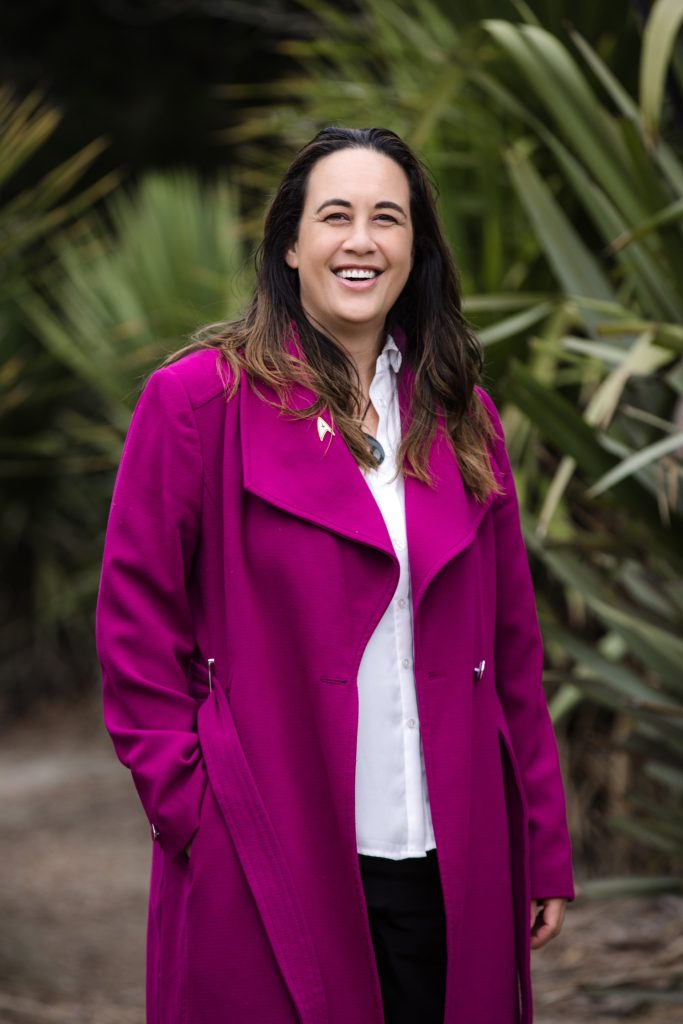
Ngāti Tamaterā, Pare Hauraki whānui | Ngāti Raukawa | Ngāti Porou | Ngāpuhi | Ngāi Tūhoe
Transformative | Strategist | Futurist | Innovator | Technologist | Systems Engineer | Speaker | WE shapes me
*Empowering People to Achieve Outcomes for the Betterment of Purpose*
Across 30 years of mahi spanning iwi, business, industry, education, government and community, she has developed a practice of observing across systems, disciplines and different ways of knowing, recognising the relationships and patterns between them, and translating foresight into practical action.
Her foundations in science, technology, business, infrastructure, and community – continue to shape the way she approaches complexity today. Elle contributes to governance and strategy at regional and national levels, alongside her mahi in iwi economic development, emergency management, advanced technologies and capability development. Increasingly, her work explores the relationships between people, technology and the systems we create, and the conditions that enable communities and future generations to flourish.
Elle describes this way of working as navigating the multiverse. It is less about moving from one world into another and more about learning to observe across different systems, disciplines and ways of knowing while respecting the integrity of each. This perspective allows her to recognise relationships that may be difficult to see from within a single system, while remaining conscious that seeing a connection does not necessarily make it hers to carry.
Alongside her applied mahi, Elle writes and speaks about stewardship, governance, technology, complexity, observation and human flourishing. Her developing bodies of work include The Ecology of Observation, Stewardship Ecology, Practices of the Steward and Notes from an Observer.
Elle lives in Ōtautahi Christchurch, with mahi taking her across Aotearoa and internationally.