On emerging technologies, Indigenous knowledge, ethics, governance and the importance of doing the mahi.
There is something I have been observing across my work in artificial intelligence, quantum technologies, photonics, digital infrastructure, governance, education, economic development and emergency management. The more these worlds intersect, the more apparent it becomes that the future of technology is not simply a question of scientific advancement or technical capability. It is also a question of relationships, values, authority, responsibility and the conditions we are creating for those who follow us.
I have had a fascination with science for as long as I can remember. Physics, in particular, captured my imagination when I was young. I was interested in understanding how the universe worked, how things interacted, and what might exist beyond the limits of what we could immediately observe. That curiosity eventually found expression in my professional work across electromagnetics, radar, geospatial systems and advanced technologies, and it continues today through my involvement in quantum and photonics.
Alongside this has been another journey, one involving my own whakapapa, identity, relationships and responsibilities as Māori. These parts of my life have not developed in isolation. They have continually influenced the questions I ask, the things I notice, and the ways I approach the environments in which I work.
I have spent much of my working life moving between different worlds, each with its own language, expectations, knowledge systems and ways of making decisions. I have come to appreciate that much of the value I can contribute lies not in treating these worlds as separate, but in recognising the relationships between them.
Increasingly, I find myself considering what Indigenous knowledge systems and ways of being can contribute to the technological futures we are creating. Not simply through the inclusion of Indigenous perspectives within existing systems, but through our ability to influence, develop, govern, own and determine the direction of technological development itself.
I am also interested in how Indigenous thinking can contribute to the evolution of technology ethics, particularly as we confront the consequences of increasingly interconnected, autonomous and resource-intensive technological systems.
There is already substantial scholarship and practice in these areas. Indigenous researchers, knowledge holders, technologists and communities have spent decades challenging assumptions about knowledge, ownership, research, sovereignty and the distribution of technological benefits. Their contributions provide important foundations for the work taking place today.
What I want to explore is how we bring these foundations into contemporary practice. How do we translate Indigenous principles into technological design, policy, governance, investment and execution? What can we learn from practitioners working across these environments? And how might our collective contributions help create better futures for people, communities and the living world?
For me, these questions are increasingly connected by one essential consideration.
Indigenous agency must be foundational.
Indigenous Agency Is Not the End Point of Inclusion
Conversations about Indigenous participation in science, technology and innovation have frequently centred on representation, consultation and inclusion. These remain important, particularly given the historical and continuing exclusion of Indigenous peoples from decisions affecting their knowledge, resources, communities and futures.
But inclusion and agency are not the same thing.
Inclusion creates an opportunity to participate. Influence creates an opportunity to shape decisions. Agency involves the ability to determine direction, exercise authority, mobilise resources, establish boundaries and act upon our own aspirations.
I believe we need to be particularly careful about presenting agency as something Indigenous peoples might eventually achieve after demonstrating sufficient participation, influence or capability within existing institutions.
Indigenous rights to self-determination do not depend upon technological expertise, financial resources or institutional maturity. Those rights are not earned through participation in somebody else’s systems. What capability, resources and institutional development influence is our ability to exercise agency effectively within particular technological environments. This is an important distinction.
The intellectual foundations for this conversation are well established. Linda Tuhiwai Smith’sDecolonizing Methodologies challenged the assumptions and power relationships embedded within research, including who determines what is researched, how knowledge is interpreted and whose interests are served. Her work helped articulate an Indigenous research agenda grounded in self-determination rather than simply participation in externally determined research programmes.
Tahu Kukutai and John Taylor’s work on Indigenous data sovereignty further developed questions of authority, control and governance in relation to data. Their edited collection, Indigenous Data Sovereignty: Toward an Agenda (2016), brings together scholars examining how data systems can reproduce colonial relationships and how Indigenous peoples can exercise authority over information concerning their communities.
These contributions remain highly relevant as emerging technologies create new forms of knowledge extraction, commercialisation, dependency and institutional power.
Consider artificial intelligence. Indigenous representation in AI policy discussions is important, but who determines the purposes for which systems are developed? Who controls the data and computational infrastructure? Who establishes the technical standards? Who owns the intellectual property? Who receives the commercial benefits? Who can challenge a system’s assumptions, require changes or refuse its use?
The same questions apply to quantum technologies, advanced communications, sensing, photonics and the infrastructure supporting them.
Many of the decisions being made today will influence research priorities, investment pathways, security arrangements, technological dependencies and commercial opportunities for decades to come. If Indigenous peoples are involved only after these foundational decisions have been made, our opportunities to exercise meaningful authority may already be constrained by the architecture of the systems themselves.
This is why I believe Indigenous agency must extend into the structures through which technological development occurs.
Research institutions, investment mechanisms, infrastructure ownership, technical standards, procurement systems, commercial partnerships and governance arrangements all influence who can participate, on what terms, and with what authority.
Agency also includes the freedom to establish our own institutions and technological pathways. Partnerships will remain important, and collaboration across different knowledge systems can produce extraordinary outcomes. But meaningful partnerships are strengthened when Indigenous peoples have the capability, resources and authority to participate on terms consistent with their own aspirations.
We should not have to rely indefinitely on being invited into institutions established and governed by others.
Nor should we assume that every technological opportunity is one we ought to pursue.
Agency includes the authority to say no, to establish boundaries, and to determine which forms of development are consistent with our responsibilities to our people, whenua and future generations.
What Indigenous Knowledge Systems Contribute to Technological Thinking
One of the most interesting aspects of working across different technological environments is how frequently we encounter questions of interconnectedness, uncertainty, dependency, consequence and responsibility.
These questions are not unfamiliar within Indigenous knowledge systems.
Within te ao Māori, whakapapa provides ways of understanding relationships and connections. Whanaungatanga recognises the responsibilities arising through relationships. Manaakitanga influences how we uphold the dignity and wellbeing of others. Kaitiakitanga concerns responsibilities of care and guardianship, while Rangatiratanga encompasses the exercise of authority and self-determination.
These concepts have depth, context and histories that cannot be reduced to convenient equivalents of contemporary management terminology. Nor should we assume that Indigenous peoples share a single worldview. Our knowledge systems are distinct, shaped by our own whakapapa, whenua, histories, languages and relationships.
Nevertheless, I believe there is considerable value in examining what these ways of understanding the world can contribute to contemporary technological practice.
Take interconnectedness.
Digital infrastructure now supports almost every dimension of modern life. Communications, healthcare, education, financial services, transport, energy systems, government services and emergency management all depend upon complex technological relationships.
Artificial intelligence introduces further dependencies involving data, computational infrastructure, suppliers, software, energy and human decision-making.
We often assess these systems through technical architectures, service maps, contractual arrangements, risk registers and organisational boundaries. These methods are necessary, but they do not always reveal the full range of relationships through which consequences are experienced.
A relational approach invites us to consider not only how technological components interact, but how people, communities, institutions and environments are affected by those interactions.
Who depends upon this system? What happens when it fails? Which relationships become vulnerable? Who possesses knowledge that is not visible through conventional technical analysis? How do consequences travel beyond the organisation making the decision?
I encounter these questions regularly through my work in emergency management, particularly in examining digital dependencies and the consequences of infrastructure disruption.
In a prolonged power outage, for example, the initial technical problem is only one part of the picture. Communications, payments, fuel distribution, health services, information access and community support arrangements may all become affected. The consequences are not necessarily experienced equally, and the most significant impacts may emerge through relationships between systems rather than within any single system.
A technical dependency assessment can identify the systems involved. But understanding the consequences for communities requires additional knowledge about how people live, what they rely upon, what alternatives exist and which relationships sustain them when formal services are disrupted.
This is where I see considerable potential for Indigenous relational thinking to strengthen existing methods.
It does not replace engineering, systems analysis or conventional risk management. It can contribute additional questions, relationships and forms of knowledge that improve our understanding of the wider system.
One of the observations I continue to return to is that the boundaries we use to organise responsibility do not necessarily reflect the boundaries of the consequences we create.
This matters enormously when designing, governing and deploying technologies that operate across multiple institutions and communities.
It also matters when considering time.
Many organisational decisions are shaped by annual budgets, strategic planning cycles, investment horizons and the tenure of current leadership. Emerging technologies, however, can create dependencies and consequences that extend well beyond those periods.
An intergenerational perspective asks us to consider what we are making possible for those who follow us, including the obligations, limitations and opportunities they may inherit.
These are not exclusively Indigenous concerns, and Indigenous approaches do not automatically produce better decisions. Their contribution must be understood within context and examined through practice.
But I believe they can help us recognise dimensions of technological development that may otherwise remain insufficiently considered.
Evolving Technology Ethics: From Principles to Practice
Technology ethics is another area where I believe Indigenous knowledge systems can make a substantial contribution.
Across my work in AI policy and governance, I have been observing how organisations attempt to translate ethical principles into policies, accountability arrangements, procurement requirements, technical decisions and everyday operational practice.
There is already considerable work informing responsible technological development. Fairness, transparency, accountability, privacy, safety, human rights, environmental sustainability and human oversight are now familiar considerations within many technology governance frameworks.
These principles matter. They establish expectations and provide organisations with ways to recognise and manage risks.
But the existence of an ethical principle does not guarantee ethical outcomes.
Much of the challenge lies in the distance between stating what we value and demonstrating how those values influence decisions.
An organisation may commit to fairness, but how is fairness defined? Whose experiences inform that definition? How are collective rights considered alongside individual rights? What happens when a system produces benefits for one group while creating disadvantages for another?
An organisation may commit to accountability, but accountability to whom? Is it limited to legal and regulatory obligations, or does it extend to communities affected by decisions they had little opportunity to influence?
An organisation may commit to sustainability, but is it examining only the operational efficiency of a technology, or also the energy, water, materials, infrastructure and supply chains required to sustain it?
I believe Indigenous knowledge systems can help deepen these conversations by bringing relational, collective, ecological and intergenerational considerations into ethical reasoning.
This is not an entirely new proposition.
The Indigenous Protocol and Artificial Intelligence Position Paper (2020), edited by Jason Edward Lewis and developed through contributions from Indigenous researchers, artists and practitioners, offers an important foundation. Contributors including Suzanne Kite, Hēmi Whaanga, Angie Abdilla and others explore how Indigenous knowledge systems can inform the development and conceptual foundations of artificial intelligence.
Kite’s contribution, How to Build Anything Ethically, is particularly relevant because it considers ethical technological development through Lakota knowledge and relationships, including relationships with the materials from which technological hardware is constructed.
This challenges us to think beyond the software, algorithm or immediate user and consider the wider material and relational conditions through which technologies exist.
The CARE Principles for Indigenous Data Governance provide another important example of Indigenous ethical thinking translated into a practical framework.
Developed through the work of the Global Indigenous Data Alliance and associated researchers, the principles emphasise Collective Benefit, Authority to Control, Responsibility and Ethics.
The 2020 publication led by Stephanie Russo Carroll and colleagues demonstrates how Indigenous data governance extends beyond conventional approaches focused primarily on the technical management and accessibility of data.
These contributions are important because they connect ethical considerations with authority, responsibility and practical governance.
They also challenge us to examine whether our technological systems are genuinely serving the people and communities whose knowledge and information they use.
I believe we can continue developing this thinking across emerging technologies.
Consider the difference between asking whether an AI system complies with an ethical policy and asking whether its development and use strengthen or diminish the relationships, capabilities, autonomy and wellbeing of the people and environments affected by it.
Both questions matter. They are not mutually exclusive. But they may lead us to examine different evidence, engage different people and make different decisions.
An AI procurement assessment, for example, might examine technical performance, privacy, security, legal compliance and commercial value. A more relational assessment could also examine implications for community autonomy, workforce capability, cultural knowledge, supplier dependency, institutional memory and long-term control over data.
A quantum infrastructure investment might consider scientific opportunity, commercial returns and security implications, while also examining access, capability development, environmental demands and the distribution of long-term benefits.
A research programme involving Indigenous knowledge might consider not only whether that knowledge can contribute to technological development, but who has authority over its use, whether particular applications are appropriate, how benefits will be shared and what responsibilities continue after the research concludes.
These are practical questions for researchers, governing bodies, procurement teams, policymakers and technologists.
Importantly, Indigenous knowledge must not become another resource that institutions extract to improve their own ethical frameworks without recognising the authority of the peoples from whom that knowledge originates.
The application of Indigenous ethics must itself be subject to Indigenous agency.
For me, the opportunity is to advance technology ethics across three interconnected dimensions: the reasoning that informs our principles, the policies and governance arrangements that give those principles effect, and the practical decisions through which technologies are researched, designed, procured, deployed, monitored and adapted.
We also need to be willing to test our assumptions.
If we believe relational and intergenerational approaches improve technological decision-making, we should examine where they add value, what consequences they help identify, how they influence decisions and what evidence demonstrates meaningful improvement.
The aspiration is not simply to produce more ethical statements about technology.
It is to contribute to technological development that supports flourishing communities, healthy ecosystems and the wellbeing of generations yet to come.
Governance Is Technological Participation
One of the strongest lessons emerging from my work across governance and emerging technologies is that technological capability and governance capability must develop together.
Innovation is frequently associated with researchers, engineers, entrepreneurs and technology companies. Yet many of the decisions determining technological outcomes are made elsewhere.
They are made in boardrooms, investment committees, public institutions, procurement processes, policy environments and organisations determining how resources will be allocated.
Governance influences what receives funding, which risks are accepted, how accountability is established, what information is required and whether an organisation possesses the capability to make informed decisions.
It also influences what questions are asked.
Across my governance mahi, including digital infrastructure, education, workforce development and emerging technologies, I have observed how technological decisions can expose broader questions of organisational purpose, capability, dependency and responsibility.
An AI adoption proposal may initially be framed around productivity, efficiency or cost reduction. Yet beneath those immediate considerations sit questions about data access, supplier concentration, workforce capability, organisational knowledge, decision-making authority and long-term institutional resilience.
What happens when an organisation becomes dependent upon technology it cannot meaningfully interrogate? How do we preserve human judgement and institutional capability? Who is accountable when an automated system influences a decision? What assurance is required when technological capabilities and risks evolve more quickly than conventional governance cycles?
These questions cannot be resolved through technical expertise alone. Nor can they be adequately addressed by governance bodies that lack sufficient understanding of the technologies they are responsible for overseeing. I believe this is particularly important for Indigenous governance.
Indigenous governors need opportunities to develop technological literacy alongside their existing cultural, commercial, strategic and fiduciary responsibilities. They need sufficient understanding to challenge assumptions, recognise dependencies and distinguish genuine opportunities from poorly understood risks.
Researchers and technologists, in turn, need to understand governance, institutional decision-making and the obligations that accompany technological development. Neither group can operate effectively in isolation.
My own work across AI policy has reinforced this repeatedly. A common policy framework may provide useful foundations, but responsible implementation cannot be achieved simply by transferring the same document between organisations.
The purpose of the organisation, its governance environment, people, cultural obligations, digital maturity, operational dependencies and risk exposure all influence how the policy should be interpreted and applied.
An education organisation, for example, must consider learning, student wellbeing, teacher capability, accessibility, privacy and the relationships between schools, whānau and communities.
An infrastructure organisation may need to place greater emphasis on operational resilience, cybersecurity, supplier dependencies, continuity of service and the consequences of system failure.
An iwi organisation may need to consider those same issues alongside rangatiratanga, collective benefit, cultural knowledge, data sovereignty, intergenerational aspirations and the authority of whānau, hapū and iwi.
These are not competing considerations. They demonstrate why ethical and effective policy requires both common principles and context-specific application.
I have also observed that governance arrangements must extend beyond policy approval.
A policy can establish expectations, but the organisation must still determine who is accountable for implementation, what capability is required, how compliance and outcomes will be assessed, and how emerging risks and opportunities will be brought back into decision-making.
This is where ethics, governance and execution become inseparable.
I believe Indigenous approaches to stewardship can make a meaningful contribution to these conversations, particularly where they encourage us to consider the relationships, responsibilities and longer-term consequences that extend beyond immediate organisational boundaries.
But cultural principles must be accompanied by sound governance practice, appropriate assurance, technical competence and the willingness to act when evidence indicates that change is required.
Quantum, AI and the Importance of Participating Early
Artificial intelligence is already changing how organisations operate, how information is produced and interpreted, and how people interact with technological systems.
Quantum technologies present a different set of opportunities and uncertainties.
Quantum computing, sensing and communications are developing along distinct pathways, with varying levels of scientific maturity and commercial readiness. Some developments may have significant implications for security, scientific research, infrastructure and industry, while others remain experimental.
My longstanding interest in physics makes these fields particularly fascinating, but I am equally interested in the institutional, economic and societal decisions taking place around the science.
Who is developing the capability? Where is the research being undertaken? How are investments being prioritised? What partnerships are being established? Who will have access to the resulting infrastructure, knowledge and commercial opportunities?
And what decisions are being made today that may determine who participates meaningfully in these fields tomorrow?
Through my involvement in quantum and photonics governance, alongside work in digital infrastructure and advanced technologies, I have been considering how we create meaningful pathways for Indigenous participation while these technological environments are still developing.
For me, this must extend beyond cultural consultation.
It includes research capability, technical education, infrastructure partnerships, investment, commercialisation, intellectual property, standards development and governance. It also requires a realistic understanding of the science.
I am fascinated by the philosophical questions that arise when considering relationships, interconnectedness, uncertainty and the nature of observation. There are areas of resonance between some Indigenous philosophical approaches and the questions explored within contemporary science.
But philosophical resonance is not scientific equivalence.
Quantum entanglement, for example, has a specific meaning within physics. It should not be presented as scientific proof of Indigenous relational philosophies, nor should Indigenous knowledge require validation through quantum theory to be considered legitimate.
Both knowledge traditions deserve to be understood on their own terms.
What interests me is the opportunity to create environments where different forms of knowledge and inquiry can contribute to richer questions and more thoughtful decisions without diminishing their distinct foundations.
That requires intellectual curiosity, humility and the willingness to recognise the limits of our expertise. It also requires practical participation.
We cannot meaningfully influence technological futures through philosophical discussion alone. We need Indigenous people developing technical capability, conducting research, building enterprises, governing institutions, shaping policy and creating pathways for others to participate.
The Economic and Institutional Foundations of Agency
Indigenous technological agency is also an economic development challenge.
It is difficult to exercise sustained influence over technological development without access to capital, infrastructure, technical capability, research opportunities, commercial relationships and institutions capable of supporting long-term participation.
These material conditions matter.
My work in iwi economic development continually brings me back to the relationship between aspiration and execution.
We can identify opportunities, establish strategies and articulate ambitious visions for future generations. But realising those aspirations requires investment, capability, commercial discipline, governance and the ability to sustain activity beyond individual projects or funding arrangements.
The same applies to emerging technologies.
If Indigenous peoples are to participate meaningfully in AI, quantum, photonics and other advanced fields, we need pathways that connect education and workforce development with research, enterprise creation, investment and institutional capability.
We need opportunities for rangatahi to encounter these technologies early, develop confidence and see themselves as researchers, engineers, entrepreneurs, governors and creators.
We need Indigenous enterprises capable of developing products and services, participating in supply chains and retaining value from the intellectual property and expertise they create.
We need research partnerships that recognise Indigenous authority and establish fair arrangements for knowledge, ownership, benefits and accountability.
And we need institutions capable of sustaining these efforts over time.
This is not about suggesting that every iwi, hapū or Indigenous community must independently develop every component of an increasingly complex technological ecosystem.
Agency can be exercised through many arrangements, including partnerships, shared infrastructure, collective investment, research alliances and institutions established to serve common purposes.
The important consideration is whether those arrangements strengthen or constrain Indigenous authority and long-term capability.
In my own mahi, I increasingly find myself thinking about the institutions we need to build rather than only the projects we need to deliver. Projects can create important opportunities. Institutions can create the conditions through which those opportunities become enduring. The distinction matters when considering technologies that may influence our societies and economies for generations.
From Thought Leadership to Applied Learning
I have enormous respect for the Indigenous scholars, knowledge holders and thought leaders who have established the intellectual foundations for these conversations. Their work has challenged assumptions, created new research agendas and opened pathways for practitioners working across contemporary technological environments.
But I believe we also need to place greater value on the knowledge generated through practice.
The people developing AI policies, negotiating technology partnerships, building infrastructure, establishing enterprises, managing technological risk, designing learning pathways and working directly with communities are generating valuable insights every day.
Much of that knowledge remains within individual organisations, projects and professional networks. We share successes, but perhaps less frequently the difficult decisions, tensions, compromises, failures and adaptations that shape our learning.
Yet these experiences are often where some of the most useful knowledge resides.
A practitioner who has attempted to incorporate Indigenous principles into an AI procurement process may have learned something that could help dozens of other organisations.
A governor who has challenged an investment proposal because its long-term dependencies were poorly understood may have developed questions worth sharing.
A researcher navigating the protection of Indigenous knowledge within a commercial partnership may have encountered issues that others are only beginning to recognise.
We should be creating more opportunities for these experiences to inform one another.
This does not mean disclosing knowledge that is confidential, commercially sensitive, culturally restricted or inappropriate to share. Responsible knowledge exchange requires judgement and respect for the authority of those to whom knowledge belongs.
But where sharing is appropriate, I believe we can be much more deliberate about turning individual experiences into collective capability.
My own approach to learning has always been strongly influenced by application.
Learn something, try it, observe what happens, reflect, adapt and share what might be useful to others.
I find myself applying this approach constantly across the different environments in which I work.
In emergency management, I have been exploring how digital dependencies can be better recognised within consequence assessment and recovery planning. The work has reinforced the importance of enabling people within different functions to identify their own dependencies, understand cascading consequences and contribute to shared situational awareness.
In AI policy, I have been examining how common ethical and governance principles need to be adapted to the purpose, maturity, responsibilities and operating environment of different organisations.
In governance, I have been considering how technological assurance can move beyond narrow compliance questions to examine institutional dependencies, capability, resilience and accountability.
In education and workforce development, I have been observing the importance of connecting technological change with the capabilities people need to participate meaningfully in it.
And through iwi economic development, I continue to encounter the practical relationships between strategy, investment, enterprise development, partnerships and the creation of intergenerational opportunity.
These experiences are not identical, and an approach that works in one environment will not necessarily work in another. But they often reveal related questions.
What are we dependent upon? Who has authority? What capabilities are missing? What consequences have we overlooked? What are we learning through implementation? And what needs to change?
I believe there is considerable value in sharing these observations across sectors.
Thought leadership helps us imagine what is possible. Applied learning helps us understand what it takes to make it possible.
Both matter.
And both become more valuable when they inform one another.
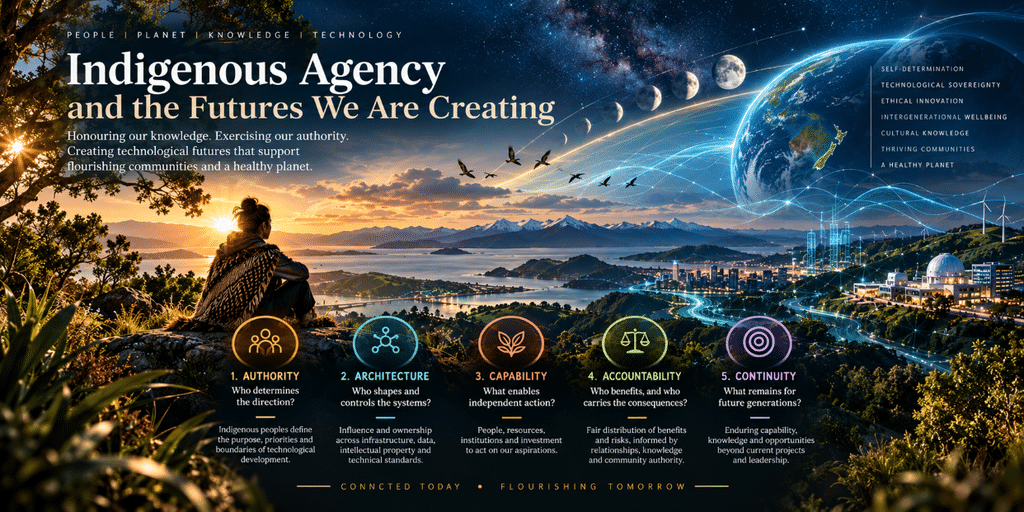
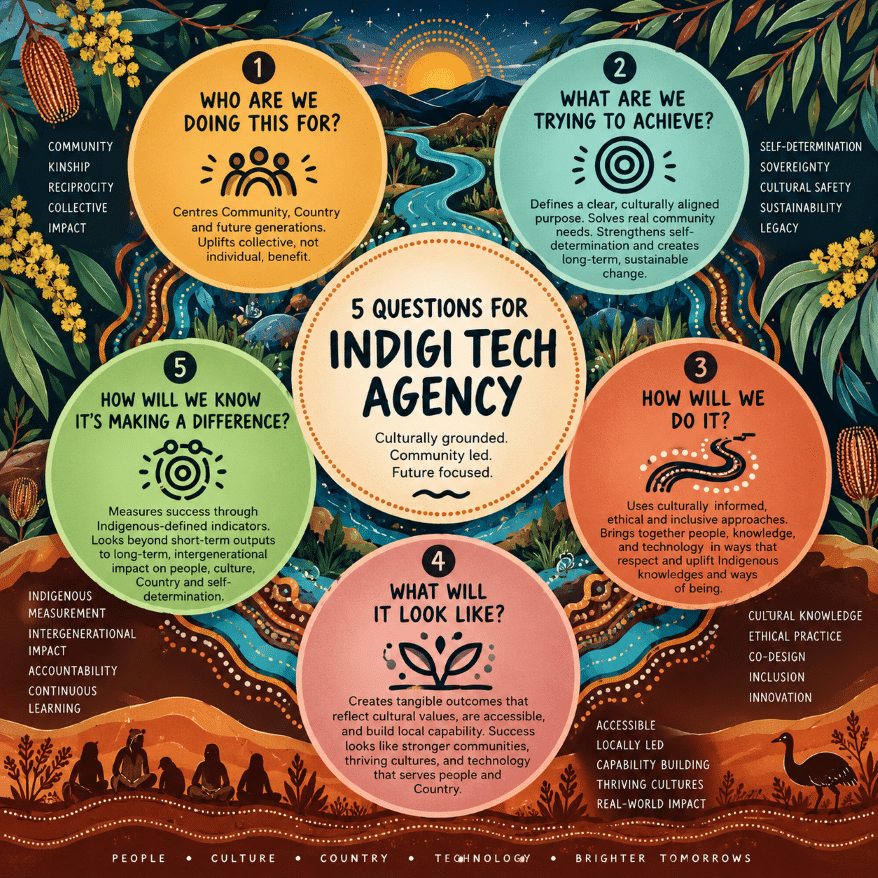
Five Questions for Indigenous Technological Agency
As I reflect on these experiences, I keep returning to the need for practical ways to examine whether Indigenous agency is genuinely being enabled.
I have been developing five interconnected questions that may help practitioners, governing bodies, researchers and organisations examine their approaches.
I do not consider these a finished or validated framework. They are an emerging practice lens, informed by my own observations and by the wider scholarship on Indigenous self-determination, data sovereignty, technological ethics and governance.
I would welcome their application, challenge and refinement by others.
Authority: Who determines the direction?
Are Indigenous peoples able to define the purpose, priorities and boundaries of technological development? Do they possess meaningful decision-making authority, including the ability to challenge or decline proposals? Or are they primarily responding to decisions already made?
This question concerns the recognition and exercise of Indigenous authority. It is not a test of whether Indigenous peoples have earned the right to participate.
Architecture: Who shapes and controls the systems?
Who owns or governs the infrastructure, data, intellectual property and technical arrangements upon which the technology depends? Are Indigenous participants able to influence foundational design choices, or are their opportunities constrained by systems developed elsewhere?
This question recognises that technological architecture can establish dependencies and distribute power long before those consequences become visible through everyday use.
Capability: What enables independent action?
Do Indigenous communities and institutions have access to the technical, commercial, financial and governance capabilities required to act upon their aspirations? What investments are being made in education, research, enterprise development and institutional capacity?
Capability does not confer the right to agency. It helps make the exercise of agency effective, sustainable and less dependent upon external institutions.
Accountability: Who benefits, and who carries the consequences?
How are benefits, risks and responsibilities distributed? Whose knowledge informs decisions? What mechanisms exist for affected communities to question outcomes, seek remedies and influence future development?
This question extends beyond formal compliance to examine the relationships and obligations created through technological development.
Continuity: What remains for future generations?
Will the knowledge, capability, authority and opportunities created through an initiative endure beyond its current funding, leadership or institutional arrangements? Are we building lasting foundations, or temporary participation dependent upon particular individuals and relationships?
This question brings intergenerational stewardship into the practical assessment of technological development.
Together, these questions offer a way of examining whether Indigenous participation is contributing to enduring agency or simply creating opportunities to participate within existing arrangements. They may also help reveal tensions between what organisations say they value and what their structures, investments and decisions actually enable.
Ethics, Ecology and the Conditions for Flourishing
Ultimately, I believe our conversations about emerging technologies must extend beyond technological capability itself.
We have become extraordinarily good at developing tools that increase the speed, scale and sophistication of what humans can do. Yet our capacity to develop technologies does not automatically mean we possess the wisdom, institutions or collective capability to use them well.
Artificial intelligence can create opportunities for learning, scientific discovery, productivity and accessibility. It can also reinforce inequities, concentrate power, increase dependencies and introduce new forms of harm.
Advanced computing and digital infrastructure can enable extraordinary innovation while requiring substantial material resources, energy, water, specialised supply chains and long-term investment.
The question is not simply whether these technologies are beneficial or harmful.
Their consequences depend upon how they are developed, governed, distributed, used and adapted.
I believe Indigenous knowledge systems can contribute to how we understand those consequences, particularly through approaches that recognise relationships between human wellbeing, community capability, ecological health and intergenerational responsibility.
The work of Indigenous scholars such as Kyle Powys Whyte is particularly relevant here. His scholarship on Indigenous environmental justice, climate change and collective responsibilities examines how ecological challenges are inseparable from histories, relationships, governance and the conditions through which communities sustain their ways of life.
These considerations have important implications for technology.
When evaluating technological development, we need to ask not only whether a system performs its intended function, but what conditions it creates within the wider environments of which it becomes part.
Does it strengthen people’s ability to participate meaningfully in their communities and economies? Does it improve resilience or create dependencies that are poorly understood? Does it distribute opportunities fairly? Does it respect the authority of communities over their knowledge and resources? Does it contribute to ecological wellbeing, or transfer environmental costs to people and places with limited influence over the decisions being made?
And what are we leaving behind?
These questions require more than good intentions.
They require evidence, informed governance, meaningful participation, accountability and the willingness to change course when our observations reveal unintended consequences. They also require us to recognise that the quality of our understanding is influenced by the relationships through which we observe the world.
This is something I have been exploring through my own developing work on the Ecology of Observation.
One of the propositions emerging from that thinking is that observation is not simply the collection of information. It is also shaped by the relationship between the observer and what is being observed.
A distant observer may accurately identify the broad features of a technological system. Someone participating in the relationships and communities affected by that system may recognise dependencies, histories and consequences that are not immediately visible from elsewhere. Neither perspective necessarily provides a complete understanding. But bringing different perspectives into meaningful relationship may improve the quality of the questions we ask and the decisions we make.
This raises an interesting proposition for technological governance. Could relational approaches to observation and assessment help us identify dependencies, consequences and responsibilities that conventional methods may overlook? Could Indigenous knowledge systems contribute to improving not only the ethical principles we adopt, but the quality of our understanding of the systems we are responsible for governing?
These are questions I believe deserve further examination through research and applied practice.
I would not claim that relational approaches will always produce better outcomes. But I do believe they offer valuable possibilities for improving how we observe, interpret and respond to complexity.
For me, this is where technology ethics, governance and stewardship begin to converge.
The measure of ethical technology should not be limited to whether we have avoided harm. We should also examine whether the conditions we create enable people, communities and the living world to flourish.
Building Agency That Endures Beyond Us
There is one further consideration that continues to occupy my thinking.
Many initiatives, particularly those involving emerging technologies and Indigenous participation, depend heavily upon committed individuals who can move between different knowledge systems, institutions and professional environments.
These people often hold substantial relationships, experience and institutional knowledge. Their contributions can be transformative.
But what happens when they leave?
If the capability, relationships and decision-making authority disappear with them, we must ask whether we have created enduring agency or simply enabled temporary participation. This is why I believe institutional development, succession, knowledge transfer and collective capability deserve greater attention. We need to build environments in which Indigenous technological agency does not depend upon the continuing presence of particular individuals.
That means developing pathways for emerging practitioners, creating opportunities for technical and governance learning, establishing institutions capable of holding knowledge and resources, and designing systems that enable others to contribute and lead.
It also means recognising when our own contribution is to create the conditions for somebody else to carry the mahi forward.
I have been thinking increasingly about stewardship in this way. Not as the accumulation of responsibility or the need to remain involved in everything we have helped create, but as the deliberate cultivation of capability, relationships and institutions that can continue beyond us.
The quality of our contribution is not necessarily measured by how much we personally retain responsibility for. Sometimes it is measured by what becomes possible when we no longer need to be there.
This is particularly important when considering technologies that may shape societies and economies long after today’s practitioners and decision-makers have moved on.
If we are serious about intergenerational responsibility, our work must extend beyond present participation and towards the creation of enduring capability.
An Invitation to Indigenous Practitioners
I am conscious that none of us holds all the answers, and that the opportunities and challenges emerging across these technological fields are substantial.
I am equally conscious of the extraordinary knowledge, capability and experience already present within Indigenous communities, research institutions, enterprises and professional networks.
There are Indigenous researchers contributing to AI and advanced science, technologists building infrastructure and digital solutions, governors challenging institutional assumptions, entrepreneurs developing commercial pathways, educators creating opportunities for future generations, and communities determining how technologies might support their own aspirations.
Much of this work is happening across different places, institutions and sectors.
I believe we have an opportunity to connect it more deliberately.
To share what we are learning. To compare approaches. To examine where our assumptions hold and where they need to change. To identify practical methods that others can adapt, while respecting the distinct knowledge systems and circumstances from which those methods emerge.
We should also be willing to challenge one another.
Indigenous knowledge systems are not beyond examination, and Indigenous participation does not automatically guarantee ethical outcomes. We still need rigorous research, sound governance, technical competence, commercial discipline, transparency and accountability. Our contributions become stronger when we combine cultural integrity with intellectual curiosity, practical capability and a willingness to learn from evidence.
For those of us working across these spaces, I believe there is a responsibility to make our learning useful to others wherever it is appropriate to do so. Not simply to describe the futures we hope to see, but to contribute to the work required to create them.
I would particularly encourage Indigenous practitioners to share the practical lessons emerging from their mahi. What have you tried? What worked? What did not? What assumptions were challenged? What would you recommend others consider? What have you learned about governance, ownership, ethics, capability and the relationships required to make technological development meaningful?
These conversations have the potential to strengthen our collective practice.
And perhaps, over time, they can contribute to a more substantial body of applied Indigenous technological knowledge that future practitioners can draw upon, challenge and continue developing.
The Futures We Choose to Create
I began this reflection by considering what Indigenous knowledge systems might contribute to emerging technologies.
But perhaps the more important question is what becomes possible when Indigenous peoples possess the agency, capability and institutional foundations to determine their own technological futures while contributing to the wider evolution of technological development.
I believe there is enormous opportunity here.
An opportunity to advance technology ethics through relational and intergenerational approaches to responsibility. To strengthen governance by recognising dependencies and consequences that conventional frameworks may overlook. To build Indigenous capability and economic opportunity in fields that will influence future societies. And to contribute to technological development that supports the wellbeing of people, communities and the living world.
None of this will happen through aspiration alone.
It will require research, investment, governance, technical development, policy reform, institutional capability and the everyday work of practitioners prepared to apply ideas, examine outcomes and share what they learn.
It will also require humility.
We must remain willing to learn from other knowledge systems, recognise uncertainty, challenge our assumptions and adapt as our understanding develops.
For me, Indigenous agency is not simply about securing a place within the technological futures being created by others.
It is about possessing the authority and capability to help determine what those futures become, including the freedom to create our own.
And perhaps that is the challenge I would leave with those of us working in these spaces.
Are we simply participating in technological change, or are we building the knowledge, relationships, institutions and capabilities required to shape what comes next?
Because the future will not be determined by technology alone.
It will also be shaped by the values we choose to uphold, the relationships we recognise, the decisions we make, and the responsibilities we are prepared to carry.
And that is mahi worth doing together.
From Thinking to Practice
There is little value in developing another set of principles if they remain confined to articles, conference presentations, governance papers or conversations among people who already agree with one another. The real work begins when we take these ideas into the places where decisions are being made, resources are being allocated, technologies are being developed, and consequences are being experienced.
The five questions I’ve offered here are not intended to be a definitive framework, nor do I claim they capture the diversity of Indigenous experiences, aspirations or ways of knowing. They are an emerging practice lens, informed by the work of others and by my own experiences across technology, governance, economic development and community systems. I offer them for others to adopt, adapt, challenge and improve. Their usefulness will be determined not by how well they read on a page, but by whether they help us recognise what we might otherwise overlook, ask better questions, make better decisions and strengthen Indigenous agency in practice.
For those working in governance, this might mean bringing the questions into boardrooms, investment decisions, procurement processes and conversations about technological risk. For researchers and technologists, it might mean examining who establishes research priorities, whose knowledge informs the design, who controls the resulting intellectual property, and what relationships and obligations continue beyond the life of a project. For iwi, hapū, Indigenous organisations and communities, it might mean identifying where we already exercise authority, where we remain dependent on systems designed by others, and what capabilities and institutions we want to develop for ourselves and our future generations.
I am particularly interested in hearing from those doing the mahi. The people building, testing, governing, teaching, investing, challenging and implementing. What have you tried? What has worked? What hasn’t? Where have you encountered resistance, unexpected consequences or opportunities that were not visible at the outset? And importantly, what have you learned that might help others? We need to make greater room for these experiences alongside scholarship and policy development, because practice generates knowledge too. Our understanding improves when we are prepared to share not only our successes, but also the assumptions we have had to reconsider.
This inquiry is also a continuation of my earlier reflections on Navigating the Multiverse, and the developing body of work I am undertaking on stewardship. The more time I spend working across different worlds, disciplines, institutions and communities, the more I recognise that the challenge is not simply learning to move between them. It is understanding what each environment reveals, what it obscures, what responsibilities we hold within it, and when our contribution is to lead, support, challenge, connect or create space for others. Having the capability to act does not necessarily mean that every responsibility is ours to carry. Equally, recognising what needs to change is of little consequence if we are unwilling to participate in changing it.
For me, this is where Indigenous agency and stewardship meet. Agency concerns our ability to determine and shape our futures. Stewardship asks us to consider how we exercise that agency, the relationships and responsibilities that accompany it, and what we leave in place for those who follow. Neither is a destination we arrive at once and for all. Both require ongoing observation, learning, judgement, participation and a willingness to revisit our assumptions as circumstances change.
The futures we are creating will not be determined by technological advancement alone. They will also be shaped by the quality of our decisions, the relationships we cultivate, the institutions we build, the knowledge we are prepared to share, and the opportunities we make possible for others. If we want Indigenous agency to endure, we must move beyond being invited into conversations about the future a
References and Further Reading
The following works provide important scholarly and practice-based foundations for the arguments developed in this essay. The five questions for Indigenous technological agency and the connections drawn from my own cross-sector mahi are presented as emerging reflections for further application and examination, rather than as an established or validated framework.
Smith, L. T. (1999; subsequent editions).Decolonizing Methodologies: Research and Indigenous Peoples. Foundational scholarship on Indigenous research, knowledge, power and self-determination.
Kukutai, T., & Taylor, J. (Eds.). (2016).Indigenous Data Sovereignty: Toward an Agenda. ANU Press. A collection examining Indigenous authority over data, representation and governance.
Lewis, J. E. (Ed.). (2020).Indigenous Protocol and Artificial Intelligence Position Paper. Indigenous Protocol and Artificial Intelligence Working Group. Contributions from Indigenous researchers, artists and practitioners exploring AI through Indigenous knowledge systems.
Kite, S. (2020).How to Build Anything Ethically. In Indigenous Protocol and Artificial Intelligence Position Paper. An exploration of ethical technological development informed by Lakota knowledge and relationships.
Carroll, S. R., et al. (2020).The CARE Principles for Indigenous Data Governance. Data Science Journal, 19(1), 43. A framework addressing Collective Benefit, Authority to Control, Responsibility and Ethics.
Global Indigenous Data Alliance.CARE Principles for Indigenous Data Governance. A practical reference for Indigenous data rights, responsibilities and governance.
Te Mana Raraunga.Principles of Māori Data Sovereignty. A foundational Aotearoa contribution to Māori authority and governance over Māori data.
Walter, M., Kukutai, T., Carroll, S. R., & Rodriguez-Lonebear, D. (Eds.). (2021).Indigenous Data Sovereignty and Policy. Routledge. Contributions examining Indigenous data, policy, representation and self-determination.
Whyte, K. P. (2017).Indigenous Climate Change Studies: Indigenizing Futures, Decolonizing the Anthropocene. English Language Notes, 55(1–2), 153–162. An important contribution to Indigenous environmental justice and responsibilities across generations.
Archer, E. (2026).Emerging practice reflections across AI policy, digital infrastructure, governance, emergency management, Indigenous economic development and the Ecology of Observation. The author’s developing applied work and observations discussed throughout this essay; not presented as an independently published research framework.
The futures we imagine influence the decisions we make today, and those decisions shape what future generations will inherit. Through our work develop...
I've been thinking a lot about music lately. It's been one of the great constants throughout my life, connecting me with people, places, cultures and ...
I have come to think of the spaces I work across as my multiverse. Not a collection of roles, but a living network of people, systems, knowledge and r...