On Technology, Stewardship, and the Cadence of Change
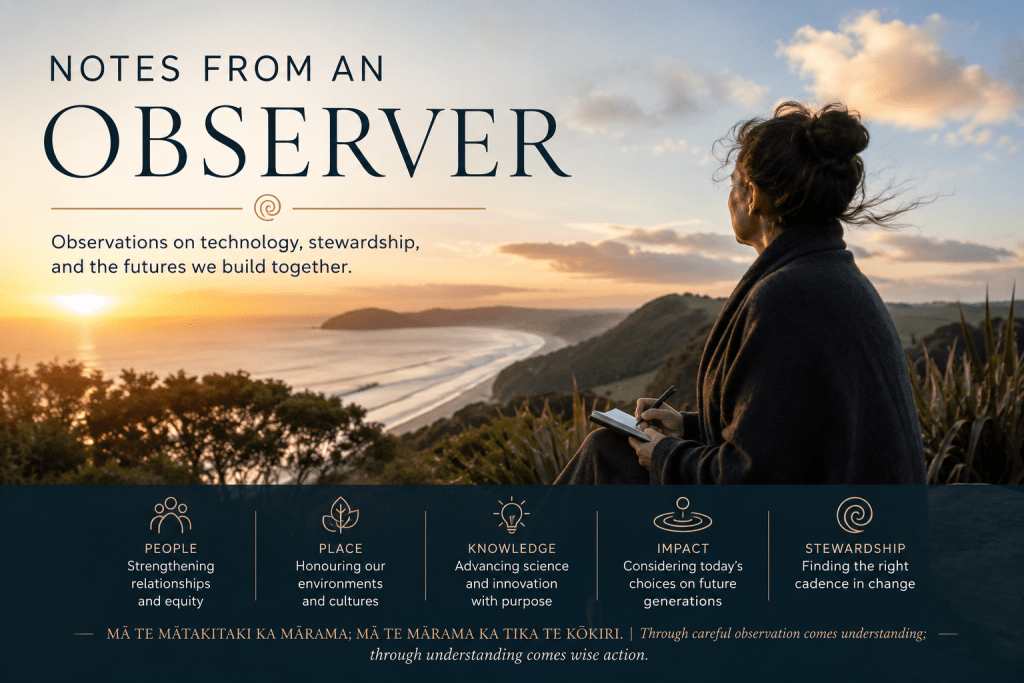
For the past few years, I’ve found myself moving between places that don’t often share the same conversations.
One day I’m sitting with educators trying to understand what artificial intelligence means for learning. The next I’m with governors considering how emerging technologies reshape organisational responsibility.
Sometimes I’m alongside iwi exploring data sovereignty and intergenerational aspirations. Other days I’m in emergency management, where decisions must be made quickly, uncertainty is constant, and trust becomes the most valuable infrastructure we have.
Then there are conversations with scientists, entrepreneurs, engineers, policy makers, researchers and community leaders, all looking at the same future from very different vantage points.
People often ask what I think about AI. Increasingly, I think that’s the wrong question.
The more interesting question is: What am I observing about us?
Because technology isn’t changing in isolation, we are.
Technology has always promised progress and sometimes it delivers extraordinary outcomes.
Medical breakthroughs save lives, science helps us understand our planet.
Engineering connects communities and innovation creates opportunities that previous generations could scarcely imagine.
We should celebrate that.
But progress is not simply measured by what becomes possible, it is also measured by what becomes better – those are not always the same thing.
Just because we can build something does not automatically mean we should – nor does it mean we should reject it.
The harder task is learning to discern the difference.
I know this is an old debate, but still highly relevant.
One of the patterns I keep noticing is our relationship with speed.
In some places, we desperately need to move faster.
Climate science, health innovation, critical infrastructure, digital inclusion, accessibility, even some parts of education.
The responsible use of AI to reduce administrative burden and give people more time for the work that only humans can do.
These are areas where unnecessary delay carries its own cost.
Communities continue to wait and opportunities pass.
Lives are affected.
But in other places, speed itself becomes the risk.
- Deploying technology before understanding its consequences.
- Automating decisions that require human judgement.
- Replacing relationships with transactions.
- Building systems that quietly amplify inequity rather than reduce it.
- Moving faster simply because competitors are moving faster.
These are moments where slowing down isn’t resistance to innovation.
It is responsible stewardship.
The challenge, then, is not deciding whether to accelerate or decelerate.
It is learning the right cadence.
- When should we move quickly?
- When should we pause?
- When do we experiment?
- When do we observe?
- When do we ask another voice into the room before making the decision?
Cadence is different from speed, it’s rhythm.
It acknowledges that healthy systems don’t operate at one constant pace.
Neither do people or communities.
Perhaps this is why ethics matters more than ever.
Not because ethics slows innovation.
But because ethics asks better questions.
- Who benefits?
- Who carries the cost?
- What relationships are strengthened?
- What relationships are weakened?
- What capabilities are we growing?
- What dependencies are we creating?
- Are we solving the right problem?
- Or simply solving the problem that technology happens to be good at solving?
Across every sector I work in, one idea keeps returning.
Technology should expand human potential, not diminish it.
It should strengthen our ability to contribute to one another, not reduce us to consumers of increasingly sophisticated systems.
It should create more room for empathy, creativity, learning, wisdom and connection – not less.
The question isn’t whether AI will transform society, it already is.
The question is whether we are intentionally shaping that transformation, or simply reacting to it.
I’m not interested in adding another framework to an already crowded landscape, the world doesn’t seem to be suffering from a shortage of models.
But it may be suffering from a shortage of collective observation.
Observation asks us to notice before we prescribe, to listen before we optimise, and to understand before we automate.
It reminds us that every decision is made within a wider ecosystem of people, places, cultures, histories, and futures.
And perhaps that’s where stewardship begins, not with having all the answers.
But with paying close enough attention to ask better questions.
As an observer, I’m not watching technology.
I’m watching humanity encounter technology.
I’m watching how leaders make decisions under uncertainty.
How educators adapt, communities respond, culture shapes innovation, trust is built – or lost, and how science, governance, economics, and human values increasingly converge.
From where I stand, the future won’t be determined by artificial intelligence alone.
It will be determined by our collective intelligence.
By our willingness to hold curiosity alongside caution, and pair innovation with wisdom.
To move boldly when the moment calls for it, and deliberately when the consequences demand it.
That’s the cadence I’m trying to learn.
And it’s the one I hope we learn together.