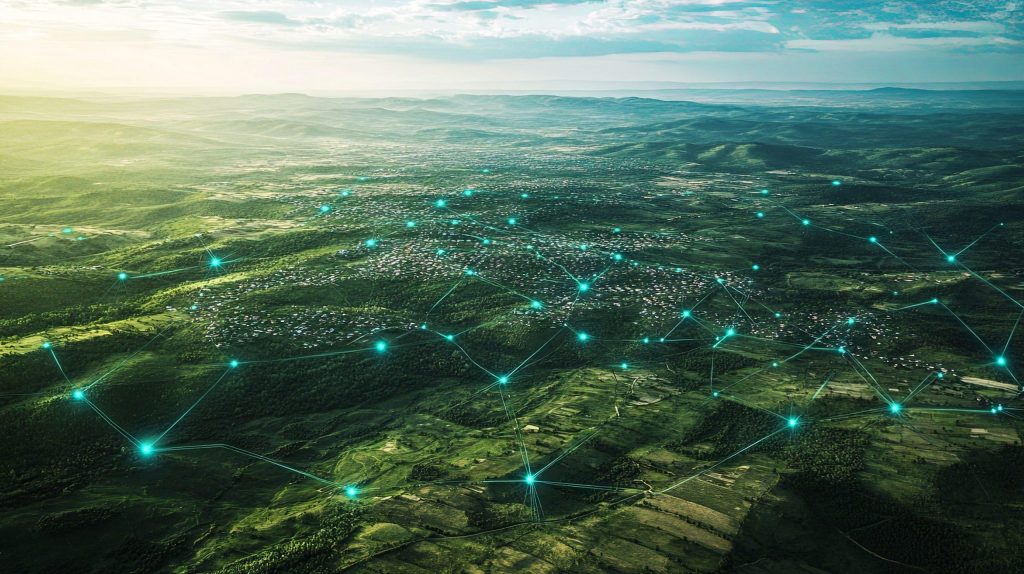
The Real Quantum Revolution
When most people hear the word ‘quantum’, they think about computers.
Faster computers, smarter AI, unbreakable encryption, scientific breakthroughs.
And yes, those things matter.
But I wonder if we’re missing the bigger story.
What if the real quantum revolution isn’t technological at all?
What if it’s philosophical?
For centuries, much of the modern world has been built upon separation.
We separate ourselves from nature.
We separate economics from wellbeing.
We separate governance from community.
We separate technology from ethics.
We separate the individual from the collective.
These separations have delivered remarkable achievements.
They have also created many of the challenges we now face.
- Climate instability.
- Social fragmentation.
- Declining trust.
- Digital exclusion.
- Extractive economic systems.
We have become exceptionally good at understanding individual parts while struggling to understand the systems they belong to.
Quantum mechanics challenges this way of thinking.
At the smallest scales of reality, relationships appear to matter as much as the things themselves.
Observation influences outcomes.
Context matters.
Potential exists before certainty.
Connection cannot always be reduced to simple cause and effect.
The deeper we look, the harder it becomes to maintain the illusion that anything truly exists in isolation.
This is where quantum theory becomes more than physics.
Not because it proves a particular philosophy.
Not because it validates one worldview over another.
But because it reminds us to ask different questions.
Less: What is this thing?
More: How is this thing connected?
Less: How do we optimise this outcome?
More: What consequences emerge across the whole system?
Less: How much can we extract?
More: How do we sustain the conditions for flourishing?
For me, this is where quantum thinking begins to intersect with stewardship.
In te ao Māori, whakapapa teaches us that nothing stands alone.
Every person, river, species, decision, generation – all exists within a web of relationships.
The health of one influences the health of another.
Responsibility travels alongside connection.
Rights travel alongside obligations.
The future is not something we inherit.
It is something we continuously create.
This matters enormously as we enter the age of artificial intelligence.
AI is accelerating our ability to act.
Quantum technologies may dramatically accelerate our ability to compute.
Yet neither technology tells us what we should do, or provides wisdom, or even determines values.
Those remain deeply human responsibilities.
Perhaps the question before us is not: How powerful can our technologies become?
But: How wise can we become alongside them?
The real quantum revolution may not occur inside a laboratory.
It may occur inside our institutions, our communities, our governance systems – inside ourselves.
The moment we stop seeing the world as disconnected pieces and start seeing it as a living system of relationships.
Because once we understand connection, stewardship becomes unavoidable.
And perhaps that is the future we are truly being invited to build.
Not a quantum computer.
A quantum society.
One capable of holding complexity, uncertainty, responsibility, and possibility all at once.