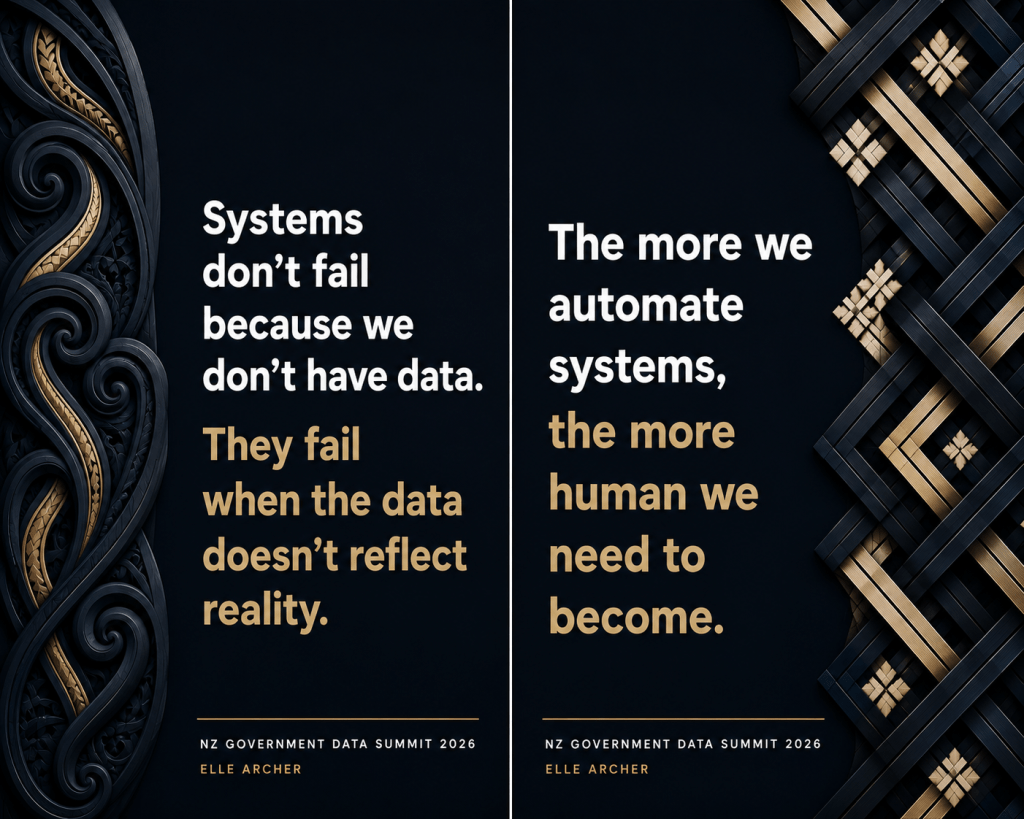
Over the past few years I have had the privilege of attending, contributing towards the work, and now Chairing the NZ Government Data Summit 2025/2026, and something has shifted in the Aotearoa New Zealand data and digital landscape.
Last year, the kōrero was clear.
We spoke about potential.
About opportunity.
About the promise of data, AI, and digital transformation.We asked:
What could we do with data?
How might AI reshape our systems?
What would a leading digital nation look like?This year, the tone changed.
We are no longer asking whether data matters, we are now being asked to prove how well we are using it.
From Aspiration to Accountability
In 2025, much of the conversation sat in aspiration:
- building capability
- exploring use cases
- understanding emerging technologies
In 2026, we saw a move into accountability:
- how are we using data in practice?
- what outcomes are being achieved?
- who is benefiting, and who is not?
This is a critical shift.
Because systems don’t change through intent alone, they change through application, reflection, and iteration.
From Strategy to Implementation
Last year, strategy dominated the conversation.
This year, the questions became far more practical:
How do we operationalise governance?
How do we move from pilots to scale?
How do we embed trust into system design?Across the summit, one theme was consistent – Governance is not something we add later, it must be designed in from the start.
From Data as Asset to Data as Relationship
Another clear evolution was how we talk about data itself.
In 2025, data was often framed as an asset.
In 2026, it was increasingly understood as a relationship.
A relationship between people and systems, individuals and institutions, communities and decision-makers.
This shift matters.
Because relationships require:
- trust
- context
- accountability
- care
And without these, even the most advanced systems will fail to deliver meaningful outcomes.
From Technology Focus to System Awareness
Last year, much of the energy sat around technology: AI tools, platforms, and possibilities.
This year, there was greater system awareness: coordination challenges, organisational capability gaps, fragmentation across agencies, trust and adoption barriers.
A simple but powerful truth emerged – we do not have a technology problem, we have a coordination, capability, and trust challenge.
From Isolated Effort to Shared Practice
One of the most encouraging shifts was the move toward collaboration.
Rather than isolated experimentation, there is now:
- increased visibility across agencies
- shared governance approaches
- cross-agency learning
- communities of practice emerging
This is where real progress will come from.
Not from individual success stories but from collective capability.
Sovereignty in Practice
Perhaps one of the most important developments this year was the embedding of sovereignty into practice.
Not just as language or intent, but through: governance models, Māori data partnerships, identity frameworks, inclusion and accessibility design, and accountability structures.
This signals a deeper maturation of the system.
One where Aotearoa is not simply adopting global models, but shaping its own.
The Work Ahead
If last year was about understanding the future, this year was about recognising that we are already in it.
The challenge now is not prediction. It is design.
Designing systems that are trusted, inclusive, resilient, and can stand under pressure
Because the systems we are building today will shape how people experience government tomorrow.
The future isn’t coming, it is already here.
And increasingly, it is being shaped not by technology alone, but by how we choose to use it.
Ngā mihi to all who contributed to this evolving kōrero, from speakers to practitioners to the wider government data hapori.
The shift is underway.
Now the work is to ensure what we build……will stand.