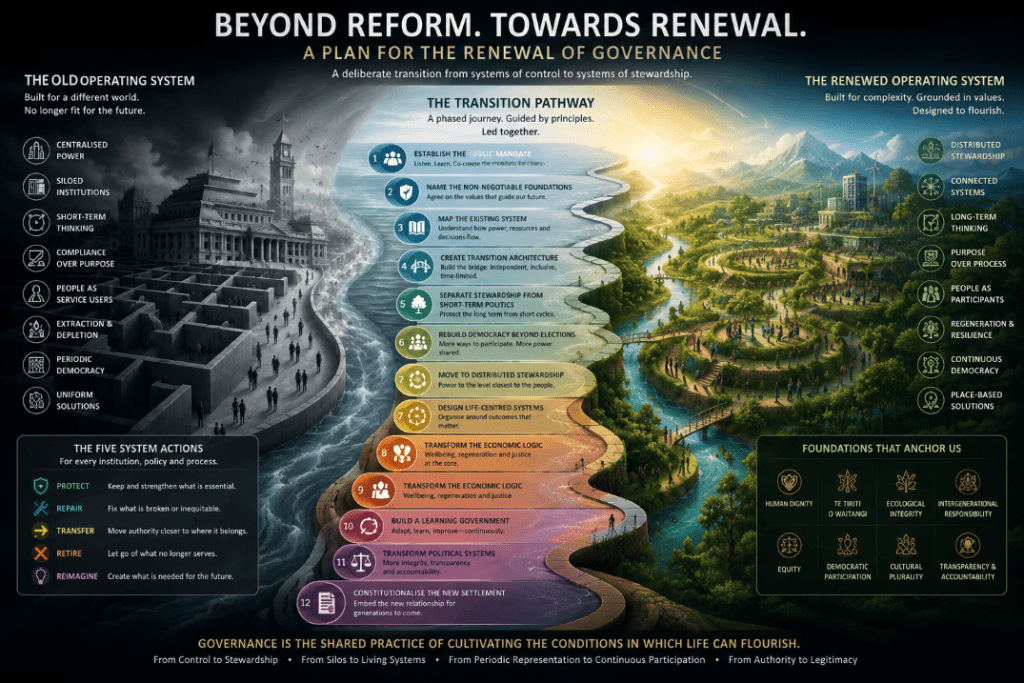
There comes a point in the life of every civilisation when repairing the existing system is no longer enough.
For generations, we have attempted to solve increasingly complex challenges by refining institutions that were designed for a very different world. We commission reviews, establish working groups, create new ministries, rewrite legislation and elect new governments. Yet despite the genuine efforts of many dedicated people, the underlying patterns remain remarkably unchanged.
This is not because our public servants have failed. Nor is it because our elected representatives lack commitment. The challenge is deeper than that.
We are attempting to navigate a twenty-first century world using an operating system whose foundations were laid centuries ago. Those institutions were built for a world of slower communication, clearer boundaries, simpler economies and more predictable patterns of change. They have served us well in many respects, but they were never designed to respond to the pace, interconnectedness and complexity of the world we now inhabit.
Today we face challenges that refuse to remain inside organisational charts or ministerial portfolios. Climate change, artificial intelligence, public health, social cohesion, indigenous rights, biodiversity, economic resilience and technological transformation all intersect with one another. They are not isolated problems waiting for isolated solutions. They are characteristics of a living system.
Our response must therefore evolve.
What follows is not a call to overthrow government. It is not an argument against democracy, nor is it an invitation to abandon the institutions that continue to protect and serve our communities every day. On the contrary, it begins from the belief that democratic governance remains one of humanity’s greatest achievements. The question is whether we now have the courage to allow it to evolve – as it has done so in the past.
The proposal that follows is an invitation to undertake something far more ambitious than institutional reform. It is a plan for democratic renewal: a deliberate, lawful and participatory transition from a model of governance built primarily for control and administration towards one centred on stewardship, adaptability and the long-term flourishing of people, place and future generations.
Rather than asking how we can make the existing system work a little better, this work asks a more fundamental question:
What forms of governance are now required for life to flourish in an age of complexity?
Answering that question requires humility. It requires imagination. It requires us to recognise that many of the institutions we inherited were extraordinary achievements for their time, while also accepting that no generation has the right to leave future generations constrained by systems that no longer serve them.
The plan outlined in these pages does not begin with dismantling institutions. It begins by understanding them. It does not seek revolution for its own sake. It seeks careful transition. It protects what remains essential, repairs what can be repaired, retires what has outlived its purpose, and creates the conditions for new forms of governance to emerge where they are needed.
This is not a blueprint for a perfect society. Such a thing has never existed.
It is a pathway towards a more adaptive one.
Because the future will not be shaped by the institutions we inherit.
It will be shaped by the institutions we have the wisdom to reimagine.
A plan for real change
Step One: Establish the public mandate for transition
Nothing this significant can be imposed by a political party, a group of experts or a charismatic leader.
The first step is a national process that helps people understand:
- what the existing system was designed to do
- where it is no longer functioning
- what must remain protected
- what should be redesigned
- what kind of future people wish to build together.
This could begin through a National Commission for Democratic and Institutional Renewal, independent of the government of the day.
Its task would not be to propose another restructure. It would facilitate a wide public examination of the state itself.
Participation would occur through:
- iwi and hapū processes
- citizens’ assemblies
- local and regional forums
- rangatahi assemblies
- disability and accessibility forums
- migrant and cultural communities
- sector-based deliberations
- digital participation
- dedicated processes for future generations and the natural world.
The output would be a public transition mandate rather than a party manifesto.
Step Two: Name the non-negotiable foundations
Before dismantling anything, the country must agree on what the new system is being built to protect.
These foundations might include:
- human dignity
- Te Tiriti o Waitangi
- democratic participation
- tino rangatiratanga
- the rule of law
- ecological integrity
- intergenerational responsibility
- equity
- cultural plurality
- freedom of expression
- transparency
- public accountability
- care for those most affected by change.
These become the constitutional guardrails for the transition.
Without agreed foundations, institutional transformation can be captured by whoever holds the most power, money, technology or influence.
Step Three: Map the existing state as an ecosystem
We cannot responsibly dismantle what we do not understand.
A whole-of-state map would identify:
- where decisions are made
- who holds formal and informal power
- where funding flows
- where information is held
- which institutions duplicate one another
- where people become trapped between agencies
- where the Crown’s obligations are fragmented
- which laws reinforce obsolete structures
- where communities already govern effectively
- which services are too important to disrupt
- where innovation is currently prevented.
This is not an organisational chart.
It is a map of relationships, dependencies, incentives, authorities, data, legislation, culture and consequences.
Every major state function would then be classified:
Protect
Functions that must remain stable throughout transition.
Examples include emergency response, health services, income support, justice, infrastructure and national security.
Repair
Functions that are necessary but inequitable, fragmented or poorly designed.
Transfer
Functions better held by iwi, local government, communities, regional institutions or specialised public bodies.
Retire
Rules, agencies, processes or reporting requirements that no longer serve a meaningful purpose.
Reimagine
Functions requiring entirely new institutional models.
Step Four: Create a temporary transition architecture
The existing government cannot be expected to redesign itself while simultaneously protecting its own incentives, conventions and power.
A temporary transition structure would be needed.
This could include:
A Transition Assembly
A representative body containing:
- Crown institutions
- iwi and hapū representatives
- local government
- citizens selected by sortition
- rangatahi
- community and sector leaders
- constitutional and systems experts
- ecological and future-generation representatives.
It would not replace Parliament immediately. It would develop, test and recommend the architecture of the next system.
A Stewardship Council
An independent body responsible for assessing whether decisions strengthen or weaken long-term wellbeing, democratic integrity, Te Tiriti relationships and ecological resilience.
A Public Transition Office
A professionally staffed institution coordinating pilots, legislation, public participation, evaluation and continuity of essential services.
A Transition Ombudsman
An independent safeguard for communities and individuals harmed or excluded during the transition.
These bodies should be time-limited. Their purpose is to create the bridge, not become another permanent bureaucracy.
Step Five: Separate stewardship from short-term political management
One of the deepest problems in contemporary government is that long-term stewardship is repeatedly overridden by short electoral cycles.
A future system should distinguish between:
- setting enduring national direction
- democratic political choice
- operational delivery
- independent guardianship
- local and indigenous authority.
Parliament should continue to make contestable political choices. But it should not be the sole guardian of the future.
Certain matters require longer-term stewardship, including:
- ecological limits
- major infrastructure
- constitutional integrity
- intergenerational equity
- data and technological governance
- national resilience
- Te Tiriti obligations.
Institutions responsible for these matters should have public legitimacy, transparent mandates and strong accountability, but should not be reset every three years.
Step Six: Rebuild democracy beyond elections
Voting is essential, but it is insufficient.
People cannot meaningfully govern themselves through a few minutes in a polling booth every several years.
A mature democratic system would combine:
- representative democracy
- participatory democracy
- deliberative democracy
- indigenous governance
- local decision-making
- digital civic participation
- direct public oversight.
Possible mechanisms include:
- permanent citizens’ assemblies
- participatory budgeting
- public policy juries
- citizens’ initiative processes
- stronger select committee powers
- community right-to-propose provisions
- transparent lobbying registers
- limits on political donations
- recall or review processes for serious failures
- public access to policy evidence and modelling
- ongoing civic education.
The purpose is not constant referenda. It is sustained participation with enough time, information and deliberation for people to exercise judgement.
Step Seven: Move from centralised delivery to distributed stewardship
Not every decision belongs in the capital.
Authority should sit at the lowest level capable of carrying it responsibly, with national coordination where necessary.
This means developing a layered system:
Whānau and community level
Local participation, mutual support and community-designed services.
Hapū, iwi and indigenous institutions
Authority grounded in whakapapa, tikanga, whenua and tino rangatiratanga.
Municipal and regional level
Place-based transport, housing, environmental management, economic development and community infrastructure.
National level
Rights, redistribution, national standards, macroeconomic coordination, justice and matters requiring collective scale.
Transnational level
Climate, migration, trade, technology, oceans, security and planetary risks.
This is not devolution as abandonment.
Resources, authority, capability and accountability must move together. Central government cannot transfer responsibility while retaining funding and control.
Step Eight: Replace departmental silos with life-centred systems
People do not experience life in government departments.
A child may simultaneously be affected by housing, education, health, income, transport, culture, disability services and neighbourhood safety. Yet the state divides that life into separate files, eligibility criteria, budgets and agencies.
Future systems should organise around life conditions and shared outcomes, such as:
- thriving children and whānau
- lifelong learning
- dignified ageing
- healthy places
- resilient communities
- meaningful work and contribution
- ecological regeneration
- cultural identity and belonging
- digital and technological wellbeing.
Departments may still exist for specialist capability, but accountability and funding should increasingly sit across shared missions rather than isolated portfolios.
Step Nine: Change the economic operating logic
Government cannot cultivate flourishing while the wider system continues to reward extraction, short-termism and the transfer of cost to future generations.
Institutional transformation therefore requires changes to:
- public finance
- taxation
- procurement
- ownership
- investment
- measurement
- competition policy
- land and resource governance.
National success cannot be reduced to economic growth.
A broader public balance sheet should account for:
- human capability
- ecological health
- infrastructure
- cultural strength
- institutional trust
- social cohesion
- resilience
- unpaid care
- future liabilities.
Every major decision should disclose who benefits, who carries the risk, what is depleted and what is being left to future generations.
Step Ten: Build government as a learning system
Current systems often treat adaptation as evidence that the original plan failed.
A complex system must expect uncertainty.
Government should operate through:
- continuous sensing
- small-scale experimentation
- rapid feedback
- transparent evaluation
- distributed learning
- safe-to-fail pilots
- sunset clauses
- regular institutional review.
Every major law and institution should have a scheduled review point.
Not merely:
Did this programme meet its targets?
But:
Does this institution still need to exist in this form?
Public servants should be rewarded for learning, collaboration and prevention—not simply compliance, budget management and ministerial responsiveness.
Step Eleven: Transform the political system itself
Political institutions cannot remain untouched while the administrative state is redesigned.
Possible reforms should be publicly considered together rather than as isolated technical adjustments:
- longer parliamentary terms balanced by stronger accountability
- greater independence between executive and legislature
- stronger parliamentary scrutiny
- transparent coalition agreements
- limits on executive urgency
- improved representation
- citizens’ chambers or assemblies
- stronger constitutional protection
- independent appointments processes
- regulation of lobbying and political financing
- mechanisms for long-term national commitments
- civics education from school onward.
Political leadership would shift from promising to control the future to helping society navigate uncertainty responsibly.
Step Twelve: Constitutionalise the new settlement
Pilots and conventions are not enough. Once tested, the new relationship between people, Crown, whenua, institutions and future generations must be given constitutional force.
A constitutional settlement could clarify:
- the authority of the state
- the place of Te Tiriti
- the distribution of power
- fundamental rights and responsibilities
- the status of future generations
- the standing of the natural world
- the role of local and indigenous governance
- emergency powers
- public participation
- the limits of executive authority
- processes for future constitutional adaptation.
The constitution itself should be capable of evolution, but not casual political manipulation.
The sequence matters
This cannot be attempted as one dramatic rupture.
A credible transition might unfold across four horizons.
Horizon One: Reveal and prepare
Years 1–2
- create the public mandate
- establish the independent commission
- map the state
- identify constitutional foundations
- protect essential services
- begin civic education
- identify communities already practising future-fit governance.
Horizon Two: Build and test
Years 2–5
- establish citizens’ assemblies
- pilot place-based governance
- test shared-outcome funding
- transfer selected authority and resources
- establish stewardship institutions
- trial new accountability and participation mechanisms
- introduce sunset and review provisions.
Horizon Three: Transition authority
Years 5–10
- retire obsolete institutions
- merge or redesign fragmented functions
- transfer agreed powers
- reform Parliament and political financing
- scale successful regional and indigenous models
- embed long-term public stewardship
- draft the constitutional settlement.
Horizon Four: Constitute and renew
Years 10 onward
- ratify the new constitutional arrangements
- complete institutional transition
- maintain continuous public evaluation
- preserve the capacity for future adaptation.
The dismantling test
Every institution, policy and process should be asked:
- What life-serving purpose does this perform?
- Who gave it authority?
- Who benefits from its current form?
- Who is excluded or harmed?
- What assumptions does it preserve?
- Could this function be performed closer to the people affected?
- Does it strengthen relationships or fragment them?
- Does it increase future capacity or consume it?
- Is it adaptable?
- Should it still exist?
If an institution cannot answer these questions convincingly, it must be repaired, transferred, replaced or retired.
What prevents this becoming another failed reform
Several disciplines would be essential.
Do not begin with structure. Begin with purpose, relationships and constitutional foundations.
Do not centralise the transformation. The new system must be practised across many places, not designed entirely from the centre.
Do not confuse speed with progress. Some obsolete rules can be removed quickly. Constitutional trust must be built carefully.
Do not allow political parties to own the process. They must participate, but the transition must belong to the public.
Do not abandon continuity. People who depend on public services cannot become collateral damage.
Do not design only for efficiency. Resilience, dignity, belonging, legitimacy and adaptability matter just as much.
Do not replace one elite with another. Expertise must serve public deliberation rather than substitute for it.
Do not build a perfect final model. Build institutions capable of learning and changing.
The deeper change
The hardest structures to dismantle will not be departments, laws or parliamentary procedures.
They will be the beliefs beneath them:
- that power must be concentrated to be effective
- that expertise belongs only to institutions
- that uniformity creates fairness
- that people are service users rather than participants
- that nature is a resource
- that culture is an addition rather than an operating system
- that politics is competition for control
- that the future can be governed through prediction
- that government is something done to people.
The future system must be based on a different proposition:
Governance is the shared practice of cultivating the conditions in which life can flourish.
That is the transition.
Not government made slightly more efficient.
Not politics with a new set of personalities.
Not another framework laid over the old world.
The deliberate transfer from control to stewardship, from silos to living systems, from periodic representation to continuous participation, from inherited authority to renewed legitimacy, and from governing the population to governing with one another.